30 March 2012

The Faded Ad Wall on West 36th: Alco Blouse Co.


This is my third investigation into the histories behind the puzzlework of faded, painted ads on the west side of the mid-sized brick tower that is 64-70 W. 36th Street.

Alco Blouse Co. moved into this building in 1938 and moved out around 1950. (All the businesses featured in these ads seemed to have been residents between the mid-'30s and mid-'60s.) Alco was, tantalizingly, "manufacturers of cotton and silk popular blouses." Popular!

Maybe they were popular because, unlike other garment makers in this building, they made things out of natural fabrics. No rayon for Alco!

I've found out who ran Alco. It was Sy H. Corak and Albert Corak. I know this because they took out an obituary in 1948 in the New York Times mourning their "beloved friend associate" Paul Henry Klein. This also gives us the key to the name. Albert Corak = Alco.

Albert liked to take out space in the Times. Albert's son Howard got engaged in 1952, and the happy occasion was featured in the broadsheet. The day before that announcement came out, Corak got in the paper for a different reason, when the police were reported to have caught a notorious cat burglar at Corak's Great Neck home.

As for Sy, in 1953 it was reported that he was developing 103 homes on Long Meadow, L.I., to be part of a housing development called Broadlawn Estates. I guess Sy made a lot of money while Alco was on W. 36th.

28 March 2012

The Faded Ad Wall on West 36th: J.D. Sachs Co.


This is post two in my search for the histories behind the faded ads that paper the west side wall of 70 W. 36th Street.

J.D. Sachs is the third painted ad from the bottom of the wall. The name is still fairly visible from the street. Less legible are the smaller messages "Infants & Children's Sportswear," and "Sizes 1 to 14." The Sachs company occupied this building from 1946 to 1960. In 1960, Sachs came up with a new skirt for girls called the "Adjust-a-Pleat." The skirt had "an adjustable band threaded with a thonged belt to allow for snug fit regardless of waist size." They were drip dry and needed no ironing, and were made of "acrilan" and rayon. You could buy than at Ohrbach's on Union Square.

I don't know what happened to the company. But in the late '70s and early '80s, you start reading about a J.D. Sachs based in Pennsylvania. Only they don't sell children's clothing. They sell mountain and outdoor gear. Perhaps the company transitioned into a new line and moved out of New York.

Brooklyn Heights' La Traviata Closes


La Traviata, a mainstay of Brooklyn Heights' Montague Street shopping strip for 34 years, has closed. Apparently, it shuttered last November, but I only just noticed. They lost their lease. Montague has become notorious in recent years for unrealistic rents and high business turnover. The landlords, greedy and short-sighted, never seem to learn. The space will reopen as a new eatery.

Lat Traviata was the subject of a May 2010 "Who Goes There?" column. Ralph Tommaso was the owner of the not-special but comforting restaurant.

The Faded Ad Wall on West 36th: Weber Original Blouses


By some miracle, a entire building wall of faded ads at 70 W. 36 Street between Sixth and Fifth Avenues has survived. There are more than a half dozen, positioned like building blocks, one on top of another, along the edge of a building just to the left of Keens Chop House. Most advertise once thriving garment companies in the area, now all vanished.

I've looked at these ads many a time. The other day, while gazing up on them again, and feeling thankful that they were still there, I was gripped by a desire to know more about the companies whose names were painted on the brick. So I've decided to decode each ad, one by one.


I'll start with one of the simplest and most clearly readable from the street. Weber Original Blouses. I like how each of the three words has a different font and a different personality.

You'll see Weber blouses advertised by vintage clothing shops on the Internet today. The company was only at this address from 1948 to 1959, after which they moved to Seventh Avenue. So I'm guessing that's when the ad dates from. The business survived until the 1970s. The outfit seems to have dealt in the then-popular man-made fabrics of nylon and dacron. Who founded it, I could not discover. I guess people don't really care that much about recording for posterity who created some little blouse company in Manhattan in the mid-20th century.

27 March 2012

The Happy End Diner


The Happy End Diner of Greenpoint looks older than its 20 years. The wonderful semi-circular counter and stools inside, in particular, make you want to tack an extra 20 years onto its age. It surely must have contained a different diner previous to the arrival of Happy End.

This is a Polish eatery in every way. The food is Polish, the menu is in Polish (there's an English version), the talk is in Polish. But the welcome is friendly. There's nothing on the bill of fare that's over $10. Tripe soup, borscht, pierogis, stuffed cabbage, kielbasa, blintzes, pig's knuckles and, my favorite, Hungarian potato pancake (it's stuffed with beef goulash). In the back, there's an additional room with a few no-frills tables. I feel you could play cards back there for hours and no one would give you the bum's rush.

25 March 2012

Mizgalski Funeral Home Leaves Greenpoint


Heavily Polish Greenpoint is where you would find a funeral parlor named Mizgalski.

On Java Street, off Manhattan Avenue, was were the mortuary sat. It seems to have closed fairly recently. The property is advertised as for sale. The handpainted name on the metal awning is touching.

23 March 2012

The Secrets of Bill's Gay Nineties


Bill's Gay Nineties closes on Saturday, March 24, possibly forever. The owners are talking about finding a new space, and they may. But regardless, it will never be the same. The bar has been in the same 1850s townhouse since opening during Prohibition. It's an irreplaceable setting for this diamond.

I'm not certain that New Yorkers realize exactly what they're losing. Yes, a former speakeasy with peerless dark-wood atmosphere and decor and a world-class collection of old theatrical and boxing memorabilia. (The owners are taking all that with them, so the restaurant that moves in will look nothing like Bill's.) We all know that. An unmatchable Old New York atmosphere. That, too. And staff who have been doing the same job at the same place for anywhere from 10 to 60 years. Ditto.

But Bill's has other hidden values, which will disappear come Sunday. Old places like this tend to, over the years, end up with pieces from other old places, ones that disappeared long ago. Take the swinging doors that lead into the basement bar. I've always admired them. But they struck me as being too ornate and fine, even for a class joint like Bill's. They seemed more 1890s than 1920s.

22 March 2012

Two Manhattan Humpbacks, in Harmony


I was looking at this monolith, the Baruch College Academic Complex, on Lexington and 24th, the other day and thought I hated it. How obnoxiously out-of-context, I thought. No respect for the surrounding neighborhood. Why that mammoth sloping glass facade?

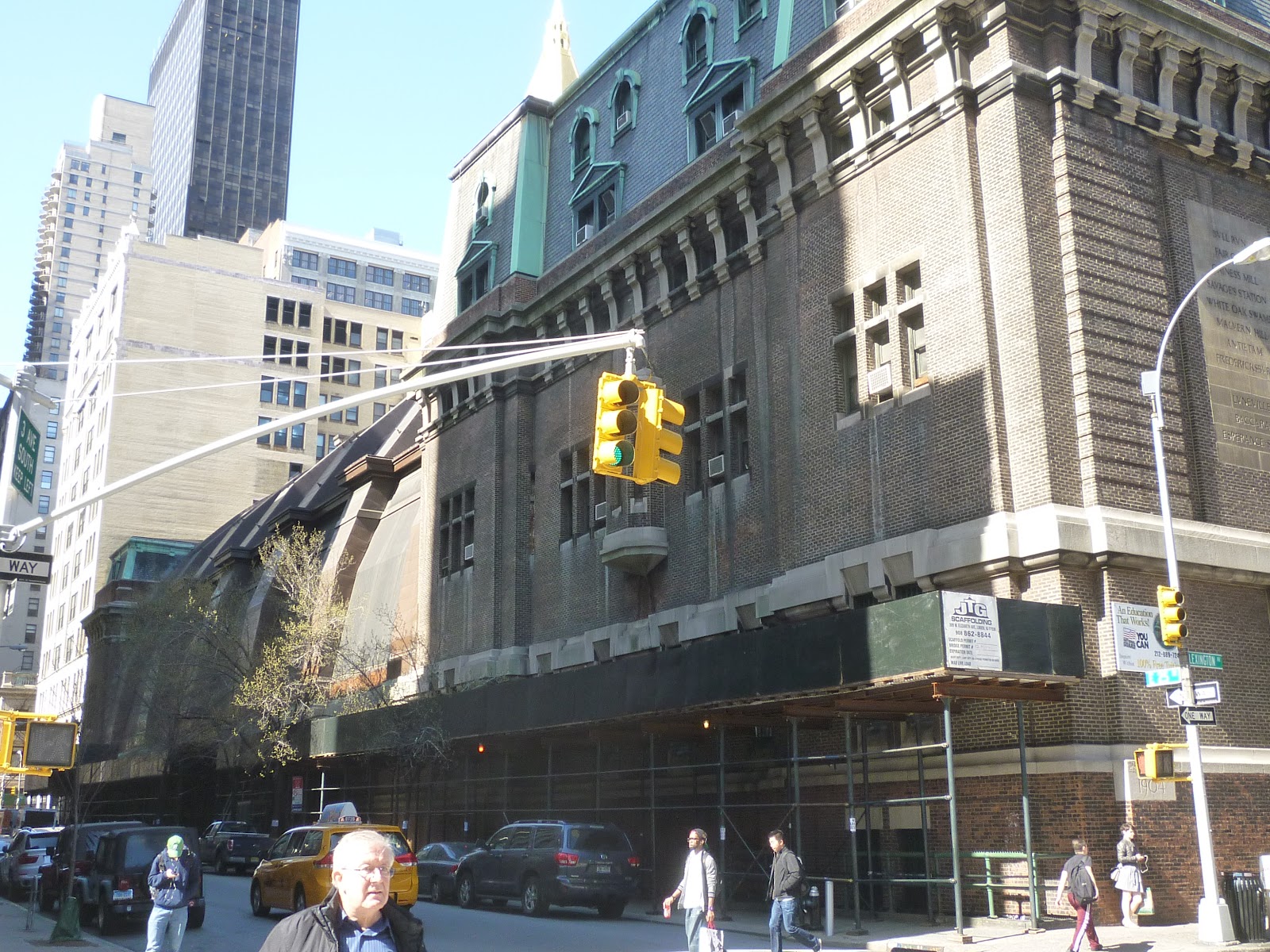
Then I turned around and walked half a block and was reminded of the nearby presence of the old 69th Regiment Armory, built in 1906. The drill hall part of the building is a hunchback itself, isn't it? The Baruch building is almost a modern reflection of its shape. I'd like to think the architects of the newer structure, built in 2000, were thinking of their neighbor when they built it. But even if they weren't, it's a lovely juxtaposition.

A Good Sign: Old Town Bar


Can't remember if I've ever said so before. But the Old Town Bar has one of the best signs in the city.

21 March 2012


The George Washington Hotel on Lexington just above 23rd is now a residence hall for School of Visual Arts students. On the outside, it's easy to pass by. The building is a weird combination of the gorgeous and the seedy. The seedy is telegraphed mainly from the metal awning that hangs over the door (below). Only the holes for the words George Washington are there, no light behind. It gives the impression the building is derelict and might be an SRO.


But look up to the second story and you see great expanses of beautiful, honey-colored brick, arranged by sunbursts around vaulted windows frames by pillars and decorative trimmings. Frank M. Andrews was the architect.

The building was erected in 1928 as a hotel and has had some famous residents, including W.H. Auden and Christopher Isherwood. Auden called it "much the nicest hotel in town." And "there is a good piano," he told visiting friend Benjamin Britten. On leaving the hotel, he presented the manager with a thank-you note in verse, written on hotel stationery. Here's one stanza: