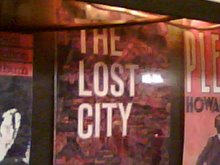
04 November 2011

Two Old Signs


I came across two old, hand-painted, wall signs this week, both exposed to the eye by ongoing construction. The above signage is on the side of a building on the east side of Lexington in the lower 60s, where a corner building has been torn down. Can't make out the top part, but whatever the store's name was, they sold gowns and wraps.

Lost City Asks "Who Goes to Big Wong?"


My latest "Who Goes There?" column took me to Chinatown to one of the great cheap-good-eats joints in the City, Big Wong. No lack of business there.
Who Goes There? Big Wong
People walk into Big Wong King holding up fingers, showing how many they are. The maitre d'—if such a high title can be used in this circumstance—then leads them into one of the two big, bare-bones rooms, which are separated by a large circular cut in the wall. "Four—THERE!" he barks, pointing at one communal table. "Two—THERE!" You're almost always going to sit with someone you don't know at this Mott Street Cantonese mainstay, because the tables are so large, and the joint is always crowded, lunchtime and dinner (which ends on the early side).
I was placed at a round table with an extended family of four—husband and wife, their son-in-law and his newborn—and a lone middle-aged man who ordered off-menu, sipped Sprite like it was whiskey and looked like the Chinatown version of Benny Southstreet. The couple said they been coming for thirty years, almost as long at Big Wong has been around. "It's amazing how consistently popular it's been," said the man. "I remember the bathrooms at the beginning," recalled the woman. "They were terrible." The food, however, has always been good, they said. And the prices always ridiculously cheap. "Five dollars?" wondered the woman about one item. "Things are getting expensive."
I ordered congee because everyone at my table was eating congee. Big Wong makes about a dozen different kinds. The husband steered me to one with beef, pork and seafood. (I appreciated more than liked it; porridge is not my thing.) He also spoke to the waitress—he was Chinese—and made sure she brought me a dish of "traditional hot sauce" to accompany my wonderful roasted pork. If he hadn't intervened, I would have been stuck with the Trappey's on the table. The housemade hot sauce made all the difference, and gave me the feeling of inner triumph that is often expressed by writer Calvin Trillin, the Chinatown devotee who always frets he's not getting the best the kitchen's got going.
Around the room was a cross-section of the city. About half the diners were Chinatown natives, who kept quiet and bent over their food. Brokers who hoofed it up from Wall Street and tucked their ties in their shirt, meanwhile, yakked it up. A foursome of college students took up one table. A couple New York City sheriffs were at another. A man immaculately dressed in a gray, pin-stripe suit and a yellow silk tie ate alone. Up near the front door, the line for take-out was impressive. The cash register was operated by a sixtysomething gentlemen with shaggy white hair who identified himself as the owner. (Officially, according to City records, the proprietor is one Judy Chan.) The married couple stated that the family that ran Big Wong wasn't necessarily the founding family, but a relation of some sort.
Big Wong bustles. The bell in the kitchen that announces the readiness of dishes never stops ringing. "Ping! Ping! Ping!" Carts of hot sweet crullers are wheeled out and carts of dirty dishes are wheeled in. "Ping!" Glasses are filled at the huge tea dispenser and slammed down on the table as patrons sit down. "Ping!" Near the front window, chefs yank down duck after duck, place the browned fowl on a cutting board that looks like a slice of oak trunk, and hack speedily away with a giant butcher knife. They can assemble an order of roast duck in sixty seconds, and not lose a finger.
—Brooks of Sheffield

A Little Bit of Gino


The other day I visited Sprinkles, the high-end cupcake place at Lexington and 60th. Up until now, I hadn't had the heart to go inside, because the chain had supplanted the wonderful and irreplaceable Italian red sauce club Gino. But, more than a year having gone by, enmity died a bit and curiosity took over. I went in to see if I could spy the tiniest bit of evidence of the address' former tenant.

And indeed I could: A whole wall of Gino's crazy red, zebra wallpaper. I remember having read at the time of Gino's exit that Sprinkles planned to retain a swatch of the wallpaper, but then I subsequently read that the wallpaper left with the chef. Both reports, it turns out, were true. The chef took the original wallpaper. So Sprinkles went back to the maker of that bizarre pattern and ordered a new length of it. The Sprinkle paper is thus cleaner than Gino's ever was. One can see how the paper looks when Gino was young.

02 November 2011

The Beauty of Schools


Lately, I've been touring some of Brooklyn's middle schools as I search for the right institution for my son, who will enter 6th grade next year. This has give me the rewarding opportunity to obverse their warm and handsome architecture. Most of the buildings we've visited were built at a time when schools were considered temples of community as important as churches and civic building, and given accordingly grand designs. No anonymous pile of bricks, these. The ceilings are high, the windows tall and plentiful, and there is an attention to detail everywhere.

These pictures are from M.S. 443 in the South Slope. There was a time when doorknobs of the sort seen above where common in New York government buildings, libraries and schools. I spied this lone survivor.

01 November 2011

Village Emigrant Saving Bank for Lease


The building that holds the Emigrant Saving Bank in Greenwich Village, on Sixth Avenue, is for lease. I would have to imagine that this means Emigrant is on the way out. I've passed by this stark gray building for decades and have grown fond of its sort of charmless charm, its Soviet-like austerity, not to mention is very, very, very subtle Art Deco touches. These days, I like it because its not a glossy piece of cheap, chain-store claptrap on an avenue full of such junk. Nobody today would knowingly build a structure like this.

The listing at Walter & Samuels says the space is available immediately.

Emigrant Savings Bank is the oldest savings bank in New York City and the largest privately owned bank in the country. It is owned by the Milstein family.  


31 October 2011

Subway Inn Is Not Dead


The horrific news spreading through the metropolis last Friday was that the Subway Inn, grand old dive of Lex and 60th, had given up the fight. The gates were rolled down, the iconic neon turned off, the phone disconnected. Many, including me, were ready to believe the worst. But one reader remained vigilant. She stopped by every night after work, and tonight the Subway was finally reopened. She took the above picture. Trick or treat? I'd say treat!

30 October 2011

White Horse Tavern Under Wraps


I walked by the historic White Horse Tavern in the West Village the other day and found the old watering hole all but obscured by a girdle of scaffolding. It's a shame to have the beautiful old building unavailable to the admiring eye, but I'm thinking (hoping, guessing) it's all to the good. DOB sheets posted outside say work is being done on the exterior including "scraping, priming and repainting the cornice and window lintels white; scraping, priming and repainting the masonry facades gray; resurfacing the deteriorated brownstone windowsills at the second floor...; removing and replacing all of the wood clapboard on the Hudson Street elevation from the southern building and repainting gray," and much more along those lines. So it seems like the place will look as good as new when all is done. I have to admit, on recent visits to the White Horse, I have surveyed the building with a worried eye. It was in bad shape.

The DOB papers also reveal a nice bit of history. The White Horse building is "a frame house built c. 1817, and was altered for use as a tavern; and that the small adjacent unnumbered building was built c. 1846-7 and later incorporated into the tavern...the cornice and storefront were altered in the mid-19th century."

29 October 2011

Lost City Asks "Who Goes to Sarge's Deli?"


Sarge's Deli in Murray Hill has been on my "Who Goes There?" list for some time. In an era when the few remaining classic Jewish delis in Manhattan have been transformed into tourist attractions known mainly for their high prices, sliding quality and political photo-ops, Sarge's is an encouraging example of a deli that just is. And after 50 years it has yet to shake off its salty, unburnished New York character. I credit its obscure location with this. If Sarge's had been on Broadway or 34th Street or Houston Street, it would have been ruined long ago. Here's my Eater column:

28 October 2011

Subway Inn May Have Gone Under


Horrible news from Eater for dive bar, Old New York, and classic neon lovers (I'm all three): 
Potentially terrible news for lovers of classic New York City bars, as it appears the Subway Inn is no longer with us. A tipster reported that "the Subway Inn looks like it has closed for good", and we turned up this picture from last night showing gates rolled down with its iconic neon lights turned off. A call to the listed phone number revealed that it has been disconnected, which hints that the Upper East Side has lost a true legend. The place seemed to have hit on hard times recently and had even resorted to selling Atomic Wings in a last ditch effort to drum up some business. Maybe this is just a temporary vacation or someone is interested in taking the space over and running a dive bar, but it ain't looking good.
If it's gone, you can add it to the fast-growing New York dive bar death toll that includes Mars Bar, the Rum House and more.

Sardi's Phone Booths Removed


Once Sardi's had a beautiful bank of wooden phone booths on the second floor. They worked and everything. Then, a year or so ago, the phones were yanked out and the booths stood empty, a victim of the bastards at Verizon, which had started fining restaurants and bars for retaining their phone booth phones. (The tragedy was repeated across town in the months to come.) But at least the booths still stood.

No longer. Sardi's phone booths are no more. The owners told me they were forced to remove them when the Fire Department complained they need more room to access the floor in case of a fire. (No doubt the department leveed a hefty fine on Sardi's and thus met some goddam Bloombergian quote.) Below, how the wall used to look.