27 February 2009

The Fall of Music Row Further Confirmed


Lost City has recently learned more to confirm my earlier report of the coming demise of Manny's Musical Instruments as well as most of what constitutes Music Row, the block of W. 48th Street between Sixth and Seventh Avenue which has for much of the last century been a destination for musicians famous and not.

A source in the know reaffirmed the fact that Music Row as we know it will be gone in just a few years, and that Rockefeller bought everything on the South side of the street. It would also appear that it was Rocky Center that decided not to renew the lease on seven-decade-old Manny's, which was purchased by Sam Ash in 1999.

Perhaps the change was inevitable. From what we hear, the spreading of the Guitar Center chain around the tri-state area (not to mention suburban Sam Ash branches) caused business to drop off on Music Row.

All in all, a sad story. And a great loss to New York's cultural heritage.

Lost City Asks "Who Goes to John's of 12th Street?"


The eternal candle at John's of 12th Street fascinates me. Can it really be true, that the owners have lit a candle in the same place every night since the 1930s, the wax building and building and building over the decades, cut back only when it gets too close to the ceiling? Could there be 70-year-old wax at the bottle of the burning, man-made stalagmite? Depression-era wax? World War II wax?

John's of 12th Street, apart from having a great name, is a cozy nook of history to enjoy a quiet bowl of pasta in. What's more, it's so unlike much of the rest of the East Village. I would love it if it were just down the block from where I live, and probably make it a haunt.

26 February 2009

Bloomberg's Bad News Week


Would-be Mayor-for-Life Mike Bloomberg didn't have such a great week—I mean, aside from closing the deal of the townhouse next to him and turning his Upper East Side home into a mansion. (No Gracie Mansion, but an actual mansion.)

King Mike, you remember, doesn't belong to any political party, since he's shed both the Democrats and the Republicans in the past seven vainglorious years. Now, of course, since he wants to be mayor for four more years—and rammed a term-limit law revision through City Council in order to do it—he needs some kind of party affiliation.

But guess what? Everybody pissed at him. Nobody wants him in their treehouse. The Republican Party of New York let me crawl to beg forgiveness on Wednesday, but gave him a cold, inconclusive reception. Seems the party has the not unreasonable idea that Mike should rejoin the party is he wants to run on the GOP ticket, but the ever unreasonable Mike doesn't want to do that.

So what's a power-mad fella to do? Well, go court the wacko Independence Party, which is run by Fred Newman, a man regarding by many as a sort of cult leader. Man, what the billionaire won't do to stay in office! But even Fred's not so keen on Bloomie.

Then again, maybe Mike needn't bother. There's a growing movement upstate in Albany to render null and void the whole term limit revision thing. The new law, if passed, "would prevent city lawmakers across the state from revising term limits laws without a voter referendum." The measure has the support they needed to advance the bills out of the appropriate committees in both houses.

The bill, sponsored in the Senate by Kevin S. Parker of Brooklyn, would apply retroactively and require a referendum on term limits in New York City in May.

Oh, and the Department of Building, which Mike supposedly fixed after two crane accidents last years revealed it to be inept, hollow and easily manipulated—is still corrupt.

Seems the guy can't catch a break. Could this be divine retribution for a Greek-Tragedy-size case of hubris? The press has caught on to Mike's streak of bad luck, too. Jacob Gershman, of the New York Post, put it best in a Feb. 23 piece called "Mike Marches Left: How Mayor Lost His Principles."

But along with his poll numbers and the city's economy, the mayor's stature is shrinking. His mockery of the political process is wearing thin among voters who were more tolerant during the good times. A Democratic lawmaker framed it like this: "The man thinks he can buy anything, and to large degree he's been right. He's not a Democrat or a Republican. He's a rich guy. That's his party."

Phil's


Phil's Pizza in the Village has long been one of my favorite New York storefronts. But I've never been able to get a shot of it that does the place justice.

Well, Ken Mac at Greenwich Village Daily Photo has done the job for me. And a pretty picture it is.

Fishs Eddy Knows a Good Joke When It Sees One


The Fishs Eddy on Broadway near Union Square wants you to know exactly what is going on with it.

25 February 2009

Some Sad Pictures of the Harlem Renaissance Ballroom


Nathan Kensinger has taken some lovely and tragic pictures of the Renaissance Ballroom and Casino in Harlem, which was never landmarked and is now all but gone. "Built between 1920 and 1923 and was a black owned and operated center of culture - a movie theater, a ballroom, a space for basketball games, dances and meetings. It was the "setting for all of Harlem’s most important parties," according to author Michael Henry Adams, but by 1979 the complex had closed down and "by the 1990s it had so deteriorated that it was used as a setting for Spike Lee’s crack den from hell in the movie Jungle Fever.""

Go check out the rest of the photos.

A Little Manny's History


My post last week that Manny's Musical Instrument closing for good in May won Lost City some traffic from unusual corners. The mainstream press took scant notice, but a sea of response from the web's various music-oriented sites and chat rooms rose up like a tidal wave, and it hasn't subsided yet. Sites like ProSoundWeb, BassTalk, BeatGearCavern and Sonormuseum are not happy.

Many of these music fans and professionals noted that Manny's had not been the same place since it was bought on by neighboring rival Sam Ash, and had some snarky things to say about the current staff at the store. The original Manny was Manny Goldrich, a saxophone salesman who founded the store in 1935. His son, Henry, took over the business later, and Henry in turn passed it to his two sons in 1998. Manny died in 1968 at the age of 64.

Manny's has always been known to attract not just serious musicians, but legendary ones. In the early years, it was famous bandleaders and jazz men like Benny Goodman and Duke Ellington. Swing Street, after all, was only four blocks away. Later, it sold to performers like Jimi Hendrix, Jimmy Page, Eric Clapton, Jeff Beck Chuck Berry and the Beatles. Buddy Holly got his Stratocaster there. Gerry & the Pacemakers would pull up in a limousine and run into the store and hide upstairs to escape the crowds of groupies who had trailed them. Harrison and Starr would hang out and sign autographs. Clapton would hock guitars during lean times. (Those times must have been some time ago.)

A book about the history of the place was published by Henry Goldrich in 2007, with reprint of many of the signed pictures that line the walls of the store.

24 February 2009

I Take the Bus


I take the bus.

I didn't always. I was a subway man. Solely. Taxis on occasion when I could afford it. Buses I'd look at through the corner of my eye and wonder why anyone would suffer their slowness, their unwieldy maneuverings through choking traffic, their creeping uncoolness. I once worked in an office alongside a folksy man originally from Arkansas who refused to take the subway on principle. He took the bus to and from his home in the Village to work in Midtown, relishing the light and air. Subways were squalid holes in the ground to him. I thought he was a kook.

Not now. Now I tend to look askance at people who don't take buses, who don't even know what buses serve their area or what their routes are. A great part of living in New York is transit—being in transit and finding the best way to negotiate transit. If you only know the subway system, you're cheating yourself out of half your options. You're going to lose the war.

I began taking buses when I moved to Brooklyn. It started with a revelation one day as I was trying to figure out the easiest way to get from my house to the Brooklyn Botanic Garden and realized I could do the trip in a straight shot, door to door, if I took the B71 along Union Street and Eastern Parkway. After that, I was hooked. Local buses could easily take me to Atlantic Avenue, BAM, Park Slope, the Brooklyn Museum, the South Slope. I became a regular on the (cursed) B61, B63, B75 and others.

Over the years, I even came to prefer the bus; if it seemed even a slightly easier commute, I would opt for a bus over the subway. I had nothing really against the subway. It was faster, there was no doubt. But the cars were more regularly crowded; seats were at a premium; the stations were filthy and depressing, and terribly hot in the summer; and people tended to behave more badly on the subway than they did on the bus. Buses were full of working people and mothers with children who minded their own business and looked out for others. Subways are home to a thousand loud-mouthed louts.

Moreover, you had to descend and ascend for the subway, and were robbed of sunshine and fresh air and scenery for the duration of your trip (except for the few strains of the subway system that travel overground.)

As I used the bus more often, I slowly began to realize that I had entered a parallel universe wholly in opposition to the American Way of Life. Successful Americans Don't Take the Bus—that was the silent message I started to perceive. It's a third-class form of transportation, way below personal vehicles, and still well under such travel modes as taxis, trains, and subways. When I mentioned the bus as a possible way to get somewhere to family and friends, they would furrow their brow and wrinkle their nose, as it suddenly detecting an unpleasant odor. The bus? Are things that bad for us?, they seemed to ask.

Looking back, I realized it had always been thus. Growing up, my family never took the bus. We didn't live in a particularly urban area, so it wasn't always an option. But for a number of years we dwelled in a fair-sized city with a decent bus system. Still, from the way my parents acted, you would never have known it. The idea was this: the bus was for poor people. If we used it, we would be allying ourselves with an undesirable social group. We would be failures. Buses were embarrassing. There was also some GOP political nonsense about how the bus system was a big waste of taxpayer money. This attitude has persisted to this day. Members of my family will not take a bus if you point a gun at their head. And I have had siblings who have lived one block from a bus stop.

I sometimes force people to take the bus. Recently, a friend visited me. I had to fight tooth and nail to get him to use the bus for a simple A-to-B journey. When he did, he said, "I've never had a good experience on a bus until today." My guess is he'd had few experience on a bus prior to that.

At this point, I'm a bit of a bus snob. If you've never partaken of the bus system, it seems to me, you haven't really fully experienced New York. On a bus, you see what lies in between the place you are and the place you want to get to. You see the neighborhoods change. You see street life. Moreover, the bus goes a lot of places that the subway system does not. Red Hook and City Island, for two examples among many.

I also take the bus as an subconscious political statement, for I hate Mayor Bloomberg's idea of New York as a "luxury city." Bloomberg, the SUV rider. Bloomberg, the fake subway enthusiast. You notice that Mayor Mike never touts the virtues of the bus system. He would never dirty the soles of his Bostonians by entering one.

Furthermore, I now think the bus fits with President Obama's call for The New Responsibility. Get over yourself; stop being selfish; stop being lazy; don't waste fossil fuels just to make things more convenient on yourself; teach your children how to use the bus; make mass transit a way of life. The bus. It's the noble way to travel.

Some Stuff That's Interesting


Pictures of the redo of Minetta Tavern have been released. Looks pretty gorgeous, with murals, caricatures and general historic spirit intact. Nice. [Eater]

The Moondance Diner, formerly of Soho, has opened in Wyoming. [Crain's]

Long Island City's landmark Pepsi sign is being reassembled. [Curbed]

Dunderheaded Rockefeller Center plans to convert the Rainbow Room into offices. Is that any way to treat a cultural landmark? [Eater]

Edwin Trinka, for 46 years the doorman at the Plaza, is retiring. [City Room]

This McDonald's is a Child's. [Ephemeral New York]

What are you looking at? [Restless]

Forgotten New York looks at some Places.

23 February 2009

A Good Sign: Killarney Rose


The Killarney Rose has been holding up its corner of Pearl Street in lower Manhattan for 41 years.

Broadway Duane Reade Wants to Look Old, But Also Doesn't Really Care


There's a Duane Reade drug store on Broadway and 20th that's making a half-assed attempt at looking like part of Old New York.

Before you enter the store, you tread over some well worn tile (far below), a remnant of whatever store used to be at this address before Duane Reade took over. Inside, though, the tile theme continues, and a variety of newer colored tiles are arranged to clearly spell out the message "Welcome to Duane Reade."

Nice! Except that the current manager of the store obviously doesn't give a good God Damn about this charming bit of artistry. Half the letters are covered up by black floor mats and a large display unit holding bottled water. "Welc to Duane Ade."


Huge Times Square Walgreens Kinda Sweet When You Think About It


At first glance, the new Walgreens at One Times Square looks like just another awful, garish big-box pharmacy. And, yes, it is that. But the store's nod to history makes it a more sentimental enterprise than is usually the case.

By moving into One Times Square (the old New York Times building), Walgreens is reclaiming old territory. The drug store chain has its first New York store in this same location in 1933, opening in the teeth of the Depression. It remained there until 1961, enjoying much of Times Square's post-War heydey. Walgreens abandoned Manhattan altogether in the 1970s.

The inner store is the usual sort of thing, except that the floor plan is exceedingly narrow, conforming to the shape of the building, and it rises up four flight, allowing for some nice views outside. If only if had an old-style soda fountain, so that Walgreens could serve up the malted milk shakes that it invented by in 1922.

22 February 2009

Strider Records Counting Down the Days?


A concerned reader wrote in recently to say that Strider Records, the small Village store devoted to vinyl, could close any day now. The man got the word from owner Bob Noguera himself, whom the reader described as "being at peace" with the reality.

If so, he may be the only one who will be at peace with it. Records maniacs—who lost Vinylmania, another Village destination for old-music lovers, in 2007—will likely be beside themselves. Me? I'm not a slavish devotee to vinyl, but I appreciate and understand those infected with the obsession, and think a neighborhood like the West Village, of all places, should have a plethora of stores that cater to such collectors.

Bob Noguera, who grew up in The Bronx, opened shop in 1979—first on Cornelia, then on Bleecker, then on Jones, all a stone's throw from each other (His block of Jones is the same one seen on the cover of Bob Dylan's album "Freewheelin’ Bob Dylan." He has devoted his life to the store, which gets calls from all over the world. He does not carry CDs, only collectible vinyl, mainly from the 1950s to the 1970s. His stores is stuffed to the gills with product and difficult to navigate; there's one narrow aisle. It's meant for serious browsing. Noguera stays close to the musical world by taking part in doo-wop groups.

I tell you, between Tin Pan Alley and Manny's and now this, music lovers in this City are suffering. Suffering.

21 February 2009

Iconic Neon Gets Its Due in Paper of Record


The New York Times' Christopher Gray delves into the critical topic of the City's landmark neon signs and their preservation on a Feb. 19 piece. The subject is much in the news lately due to the removal of the widely familiar P&G Cafe sign at 73rd and Amsterdam. The sign was landmarked and, while the owners, who are moving their business uptown, had the right to remove the sign, they apparently did not follow exact City protocol in doing so.

Gray, one of my favorite Gray Lady scribblers, talks about many of the signs that Lost City has obsessed over for years, including the Dublin House, Russ & Daughters and Gringer Appliances. And he does some nifty homework.

Gray notes that, "of a sample of a dozen notable neon signs in Manhattan, the earliest appears to be from 1933: that of Dublin House, a bar at 225 West 79th Street. Its sign was commissioned by the lessee, the Dublin-born John P. Carway, for whom E. G. Clarke Inc. designed a great two-sided sign with a green harp, and “BAR” and “TAP ROOM” flashing on and off — a masterpiece in neon."

Finally, someone at the Paper of Record says what we all know: certain neon signs are masterpieces, and should be protected and cherished.

We also learn about Charles Karsch, a Yiddish-speaking immigrant, and a master of neon art. He created the signs for the White Horse Tavern, Gringer Appliances and P&G! That's like saying one architect was responsible for the Empire State Building, the Chrysler Building and the Woolworth Building. There should be a statue of him somewhere in the City! How many hundreds of hours of joy has he brought to generations of New Yorkers?

Gray also discovers that the cost of restoring old neon is not an argument against doing it:

Mr. Friedman said that his firm was making more neon signs than ever. And there is plenty of neon innovation out there, like the tumbled letters of BAR that proclaim the Essex Street Alehouse on Essex near Houston Street, and the moody blue script of the Nightingale, a lounge on Second Avenue at 13th Street.

His firm restored both the Gringer and Russ & Daughters signs. Mr. Friedman says the cost of putting vintage neon to rights is not an argument against it. While an entirely new neon sign like Gringer’s would be about $20,000, he says restoring one much like it would cost about $10,000, roughly the same as an entirely new plastic one.

New, But Not Good, News About Vesuvio


The New York Times digs into the Vesuvio Bakery mystery in tomorrow's paper, trying to figure out what's been going on with the iconic Soho storefront in the several months since its closed last year (and nicely linking to some Lost City coverage in the process).

Here's what they found out, and none of it's very encouraging:


Finally, near the end of last month, a “for rent” sign appeared in the window, and earlier last week, a real estate broker could be seen examining the space for clients who, he said, were interested in opening an epicurean deli.

One issue underlying these seemingly mysterious twists and turns is a dispute involving the bakery’s owners and the landlord of the six-story building whose ground floor the business occupied.

“My first choice would be to have continued on and have a historic bakery in a historic building,” said William Korn, a part owner of the building who lives in Colorado. “That’s not how it worked out.”

On Wednesday, under a court- ordered eviction, the bakery’s lock was changed, the landlords’ lawyer said.


So, Vesuvio won't be coming back after all. All we can hope is that the new tenant keeps the great storefront in tact, and does something in the line of food service.

20 February 2009

Manny's to Close in May; Entire Music Row of W. 48th Street Endangered


Manny's Musical Instruments, a Midtown landmark since 1935, will close its doors forever at the end of May, and the remainder of the Music Row—as the block of W. 48th Street between Seventh and Sixth Avenues is affectionately known—may soon fall like a row of dominoes.

Following up on a reader's tip, I paid a call on Manny's today and was told by a staff member that the store would shutter at the end of the May. Manny's was bought out in 1999 by Sam Ash, the musical 300-pound gorilla of Music Row and the most visible merchant on the street. A man from Sam Ash called a meeting at Manny's last Saturday and dropped the bomb that, after 74 years, Manny's would be put out of business. Some Manny's employees may be taken on by other Sam Ash stores here and in Jersey.


According to the clerk, however, that may only be the beginning of it. The folks from Rockefeller Center have apparently been buying up parts of the block, included a mammoth parking garage that lies across the street, and aim to level the entire street so that the Center can expand across Sixth Avenue. Put simply, Music Row, one of the last real vestiges of Old Times Square, will cease to exist.

Comments made by Paul Ash, president of Sam Ash Music, to The Real Deal in 2008, do not encourage one to think that Ash will put up a fight. "It's inevitable that Music Row is going to end," said Paul Ash, "One day, both of these corners will be built up like [they are] on the other end of the block, and we're just waiting for the shoe to drop."

Manny's sits on property owned by its founding family. In the same Real Deal article, Ian Goldrich, Manny's grandson, said "I get at least a call a day from someone who wants to buy the building."

Over the years, Manny's has serviced such clients as Benny Goodman, Charlie Parker, Buddy Holly, the Beatles to Jimi Hendrix, U2, Eric Clapton and Nirvana. This almost hurts even more than the recent news that Tin Pan Alley might be torn down, because Music Row still exists. It's alive and functioning.

Lost City's Guide to the Upper West Side


If you want to understand the toll the last 16 years of short-sighted City Hall governance has taken on the City's soul, the quickest way is to take a dispiriting stroll down upper Broadway, anywhere between Columbus Circle and 96th Street. The central vein of the Upper West Side—a neighborhood that was long a bastion of New York's penchant for independent thinking and expression—has been almost completely denuded of local, individualized businesses. On some blocks, it's impossible to find a single storefront that isn't an outpost of some corporate entity. It could be Dayton or Scottsdale, for all the personality. As with SoHo, without the unique architecture, the area would be completely undistinguished.

The Upper West Side is a large chunk of land, and, quite frankly, what you get in living history for walking all those blocks doesn't quite compensate for your aching dogs. But, for those who are really curious, here's some of what's left:

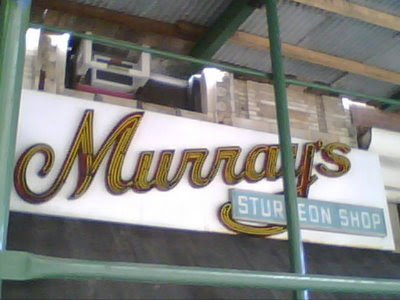
MURRAY'S STURGEON SHOP
: We'll start way the hell up north, on Broadway near 90th Street, with one of the region's mercantile gems. This narrow store has been here serving up fish and meats and soup since 1946 under several different owners. The current owner, Ira Goller, has been there since 1990.


BARNEY GREENGRASS:
"The Sturgeon King." To a certain extent, culinary life on the UWS has always centered on the finding and consuming of very good smoked fish. At Amsterdam and 86th Street, you get some of the best. Barney Greengrass (what a name!) has been luring them inside in droves for a century with its classic version of the Jewish "Appetizing" store. There's an accompanying restaurant, whose few tables are crammed together and routinely occupied.


WEST PARK PRESBYTERIAN CHURCH: Next door to Barney is this slice of red sandstone. The UWS has a lot of great churches. I'm including this one, however, because through some mystery it has never been landmarked. The 1890 building is a rare example of Richardsonian Revival, a robust style I dearly love. The church is currently closed and things don't look good for it.

AMERICAN MUSEUM OF NATURAL HISTORY: Go over to Columbus and walk off all the food from Murray's and Barney's on the way down to 81st Street, where the huge Museum of Natural History takes up a few blocks. Take it in. It's kinda impressive. If you decide to go in, don't forget to go to the Hall of Ocean Life and stand under the model of the Blue Whale. Nothing quite places you in New York as does standing under that whale.

DUBLIN HOUSE: Turn west on 79th Street and head to Broadway. You can't miss the Dublin House. It's got a big neon harp outside. A great old watering hole as old an any business in the area.

ZABAR'S: OK, now you're within the UWS's heart of hearts—the tight ten blocks or so where the neighborhood still looks and acts the most like itself. Landmarks, both of the architectural and cultural kind, are thick on the ground from 81st to 71st, starting with the business that perhaps epitomizes La Vie Upper West Side more than any other: Zabar's. Crowded, cluttered, full of itself, beloved, hated, overproud and justifiable so. However you slice it, it's an experience.

WESTSIDER RARE & USED BOOKS
: A narrow, hard-to-navigate, used book store across Broadway from Zabar's. A quintessentially New Yorky space and business. It's easy to lose a couple hours in here.


H&H BAGELS: Head south a block and enter the boiled-dough shrine that is H&H Bagels, as praiseworthy for its fat, circular bread products as for its spare, unshowy (save the weird chandeliers, above) decor.

THE APTHORP
: At 79th is the Anthorp, one of those places where every New Yorker, at one time in their lives, dreams of living. Built on land acquired by William Waldorf Astor in 1879, and filling a full city block, it has an enormous, dreamy inner courtyard that evokes Europe, and the feel of a Renaissance palace. It should. It was modeled on the Pitti Palace.

FAIRWAY: Further down Broadway, around 75th. The food miracles keep coming. This is the original, the hopelessly crowded, the infuriating, the spendiferous Fairway. "Unlike Any Other Market." And they're right. It is. It's like a Middle-Eastern bazaar, in its multitude of products and its boisterous, rude, heterogeneous clientele—only with a roof.

CITARELLA
: Never my fishy cup of tea (a little too hoity-toity, and too pricey), but generations of New Yorkers have sworn by it. It's 97 years old, for Christ's sake. I give it its due.

THE BEACON THEATRE: At 74th Street on the east side of Broadway, a 1929 Art Deco gem, recently restored.

FISCHER BROTHERS AND LESLIE: Turn right at 72nd. Half a block in, on the south side, is the family-owned butcher Fischer Brothers and Leslie. Hideously expensive, but they know what they're doing, meat-wise, and they keep the Glatt Kosher flame burning on the UWS.

72nd STREET SUBWAY KIOSK
: As you turn around and re-cross Broadway, look at and admire the landmarked subway kiosk at the 72nd Street stop. If every subway station had a kiosk like this, what a place New York would be! It's 105 years old. One of only a few remaining in the City.

THE DORILTON
: Glance down Broadway to 71st Street. That big red-and-white buster on the left is the Dorilton, built in 1902.

TIP TOP SHOES: Keep going east and head to this largish, 69-year-old rarity: an enduring family-owned shoe store! Lots of New York personality. (Maybe too much; charm, the sales clerks sometimes lack.) And the name and sign are to swoon from.

THE DAKOTA: Keep going east until you hit the park. Here is the Dakota. If you've never heard of it, there's something wrong with you. Built in 1880, it was so named because its then-surroundings were as empty and desolate as the Badlands. It has another of those great inner courtyards you only find in large apartment buildings on the UWS. All famous Upper West Siders who haven't lived at the Apthorp has lived at the Dakota.

EMERALD INN: Double back to Columbus and walk down to 70th. Nothing so special, except that it's been around for 70 years or so. Recently, it was threatened with extinction. Drink up; you're almost done walking.

TAVERN ON THE GREEN: In Central Park, near 67th, it the sprawling, be-mirrored, over-chandeliered, ever-cheesy Tavern on the Green. But it's one of a kind. And when you're eating your Eggs Benedict in the Crystal Room on a Sunday morning and the equestrians gallop up outside the glass wall to rest their horses, it can be kind of magical.

CAFE DES ARTISTES
: On 67th near the park, it is 92 years old and a byword for romantic dining. Known for its murals. The kind of New York landmark that wouldn't change if you held a nice to its throat.

19 February 2009

Gino in Danger


I'm sorry, but what is going on? I was just at Gino, the Upper East Side red-sauce stalwart, and it was crowded—on a Wednesday, at 7 PM, in a recession.

And now it's reported, by Eater via the Times, that the 64-year-old place is on the verge of extinction?

When you’re 64 years you feel the chill a bit more than the younger folks. So if the economy doesn’t warm up, said Michael Miele, the chef and one of the owners of Gino on the Upper East Side, the restaurant will close.

Mr. Miele was one of the trio of Gino employees who bought the place in 1980 from Gino Circiello, who opened the Upper East Side icon in 1945. (The others were Sal Doria and Mario Laviano, who died in 2006.)

“We’re down 70 percent over the past couple years,” he said, “especially now, forget it, we’ve got a big drop. If business stays like this, if it doesn’t pick up we can’t afford to stay open, we’re losing money.”


The zebras must not die! Here are a few possibly helpful suggestions for the old boys, should they choose to take them. Gino, you are an expensive restaurant, even for things like pasta. Try adding a few more economical items on the menu. How about a dinner prix fixe, something that would allow a diner to get out for under $30? A better, more thoughtful wine list wouldn't hurt. And try making better drinks; the cocktail are big, but on the sloppy side.

I Have a Bone to Pick With McDonald's


Time for a little off-topic rant.

First of all, I went into the McDonald's on Canal Street to use their ATM not to buy food. Not that I haven't ever purchased food there. I have. I just don't want to talk about that right now.

So, on to the subject at hand. See the little yellow sign on the McDonald's awning? "Free ATM." How do you take that? I take it to mean: a no-fee ATM. I can use it and my bank account with be charged zip. That is, of course, how everyone would interpret it.


Now let's look at these lovelies, pasted on the doors. "Free ATM." An exclamation point even. And no, I didn't see the tiny letters that said "for participating banks." Why? Because they are FIFTY TIMES SMALLER THAN THE WORD "FREE!"

And so I go in and, Whammo!, here's Mr. ATM, and he says to me (again in yellow) "99 cents," "99 cents," "99 cents." No "Free!" sticker on this baby! You pay money, buster, to touch me!

WTF? Is there a more egregious bait-and-switch in town? And this seems to be new to me, for I remember well when McDonald's used to have signs outside its franchise advertising its ATMs as "Only 99 cents!" Which was true, and cheap. Why change? Why lie? To get suckers like me into your fetid restaurants to graze off your dollar menu, that's why. Just goes to show you—ain't nothing free in a corporate outpost. Even if they take a little bit of your soul, they take something.

South Brooklyn: Land of Displaced Book Stores


Heights Books—which, we learned last year, had to vacate its longtime home on Montague Street—has found a new home at 120 Smith Street.

This area of Brooklyn is suddenly becoming quite literary. This is the second time in a year that a homeless book store has found new roots in the South Brooklyn area. In 2008, Manhattan's 12th Street Books relocated on Atlantic Avenue, renaming itself Atlantic Books. (No word on whether Heights Books will consider a name change—it'll be in Cobble Hill, technically.)

These two stores, combined with the venerable Book Court and dusty Community Book Store, give the neighborhood the number of book store choices a region populated by authors, editors, critics and journalists should have.

Two-Item Diner Goes Expansive!


The Piccolo Cafe on Columbia Street in Brooklyn, which last month opened with only two items on the menu—an egg sandwich and a cheeseburger—has been expanding like crazy! Why, there must be at least ten things on that menu now!

Italian sausage on a roll, eggplant parmigiana on a roll, chicken parmigiana on roll, cold cuts on a roll—man, if you want anything on a roll, this is the place to go. If you're a bowl kind of guy, go for the Minestrone. And they're got fries! Yes, sir. The foreign delicacy, French fries.

Seriously, though, I don't know is the stretching of the menu mean Piccolo is doing well, or the owner realized you can't make a go of thing with only two food selections. It's fun to watch the place evolve.

18 February 2009

Where Diamond Jim Brady Got Laid


I write enough about the City's old taverns, you'd think I'd know every musty watering hole in town. I guess not. A reader wrote in recently and asked if I'd ever been to his favorite dive, the Grand Saloon on 23rd Street near Lex. What? Who? Neverhudduvit.

I have an out. Grand Saloon had been called a million things since it began life in the 1880s, so its history isn't as obvious as, say, McSorley's, which has been just one thing forever. It housed a brothel during the days of "Diamond" Jim Brady, who was a frequent patron. It was called the St. Blaize Hotel & Restaurant in those days.


In 1911 it became Klube's Steak House, as the lettering about the door still states. I like the pictures on either side of a lobster and a plate of fruit, showing just what sports like Brady ate, and how much. It was a speakeasy in the 1920s.


The new owners have done a nice restoration, even if the interior is scrubbed a tad too clean. The tile floor is obviously original. They say they removed the ceiling and found a tin ceiling underneath, which they restored. They also uncovered the brick fireplace. It's a nice place to get a drink. It needs to be lived in a bit more, though.

A Survivor in Downtown Brooklyn


Downtown Brooklyn is the Bermuda's Triangle of historic New York. Nothing survives here, not even Gage & Tollner. Everything of value goes down and is replaced by something of unspeakable ugliness. So the Souvlaki House on Lawrence Street near Fulton is a kind of a miracle. Thirty-eight years in the same location! Good prices, and a nice, old-fashioned lunch counter.

Some Stuff That's Interesting


The Day-O restaurant, long vacant on W. 12th, has finally been repossessed. [Eater]

Some guys from Austin bought the interior of the old Cedar Tavern. Why does New York keep shipping its treasure out of town? [Grub Street]

The owners of P&G Bar and Grill did quite follow procedure when removing their iconic neon sign. [City Room]

The mystery of the long-closed Two Boots restaurant on Avenue A dissected. [EV Grieve]

Neat pictures of the decaying (and landmarked) Samuel R. Smith Infirmary building on Staten Island. [Kingston Lounge]

The Peter Pan Donut & Pastry Shop celebrated. [The World According to Bitchcakes]

17 February 2009

Red Hook Mystery Solved


Gothamist today did a run-down of various mysterious storefronts on Van Brunt Street, and what the work being done on them may portend.

I believe I can shed some light on one of the mystery addresses, the plywooded-up corner spot at the southeast corner of Dikeman. This, I hear tell, is going to be a combination eatery/cocktail joint going by the name of Fort Defiance (a nod to Red Hook's military past). The cocktails will be haute, along the lines of those found at Clover Club and the like.

UPDATE: I am informed by a reader that Gowanus Lounge actually reported this news back in Jan. 28 (although that item identified the cross street as Van Dyke, not Dikeman). Apologies. Had no idea. Anyway, the owner, I believe is a veteran of Manhattan's swank Pegu Club.

Car Cozy


Boy, it was chilly last night! How chilly was it? It was so chilly, the cars were wearing coats!

I was walking down W. 37th Street near Eighth last night when I noticed this old compact car completely covered by what I can only call a car cozy. At first I thought it was the work of a very inventive, but slightly cracked, New Yorker who cared a little too much about his or her car's welfare. Like those pet owners who buy their mutts elaborate wardrobes.

On closer examination, I realized it was an artwork, part of a small exhibition currently taking up the Chashama space on that block. (You can see the show in the background, behind the glass storefront.) The cozy is actually a patchwork of separate pieces of knitting, but it fits perfectly, particularly around the rear-view mirrors. The art show runs through this Sunday.

16 February 2009

Mesa De Development


On W. 28th Street in Manhattan, a construction outfit seems to have taken up makeshift residence in a former Spanish restaurant, called the Mesa De Espana. It's kind of funny, because the company has done nothing to alter the former restaurant's appearance. The signs and awnings are still there. It still has one of those typical whitewashed facades you see on Spanish eateries in this town, with ironwork over the small windows, and ceramic tiles placed here and there.

The restaurant closed only reception. I assume the construction guys have something to do with the huge development project going up next door.

Roll Call


In a hearkening back to Medieval times, when, in the exchange of goods, you didn't deal with representations of items (such as paper money or checks or internet sites), but the items themselves, the Met Food on Henry Street in Carroll Gardens has come up with a straightforward approach to check out. Instead of constantly referring a laminated price sheet which lists the cost of every kind of bread, a cashier has simply nailed each different sort of loaf to a board, placed right above her register, and tacked the corresponding prices right on to the bakery.

Ingenious, and charming. But I'm thinking any nighttime mice and rats are looking at the board and yelling: "Partytime!"

14 February 2009

A Good Sign: Midtown Lumber


On West 25th Street.

13 February 2009

Lost City's Guide to SoHo


The very idea of a history-minded walk around SoHo is depressing. The buildings are there, certainly. Cast-iron masterpieces are in surplus. But nothing of great value lives inside (great cost, yes). No ancient merchants. No artists. No tradition. Just commercial chain-store mundanity. Rough and tumble SoHo once teemed with industry. In the 1970s and 1980s it found a new pulse as a haven for art and artists. Shopping and restaurants followed, which was fine, as long as the culture remained. But the artists decamped for Chelsea in the 1990s, leaving only Pottery Barn and J. Crew to bask in the reflected glory of the Belgian Blocks. There's very little living history to choose from here, but what there is I list below.

JOE'S DAIRY: For whatever reason, the greatest density of old (mostly Italian) SoHo institutions lies on Sullivan Street, beginning with Joe's Dairy, an ancient cheese shop near Houston Street. They make sandwiches, too. The Catholic church ST. ANTHONY OF PADUA is across the street. It was built in 1888 and remains the center of Italian life in this neighborhood.

PINO'S PRIME MEAT: Just across the street and down the block is Pino's, a small butcher that does things the old way. There's been a butcher here for a century. Pino Cinquemani began his occupation of the address in 1990. He obviously didn't change much about the look of the place.

PORTO RICO IMPORTING COMPANY: Turn left at Prince Street and then right on Thompson for half a block. The 101-year-old, family-owned Porto Rico has four shops in Manhattan, but this odd, narrow, aging storefront is the charmer for me.

FAMOUS BEN'S PIZZA: Continue south. Ben's has been at the corner of Spring and Thompson for, well, not forever, but what seems like forever. It's a good source of an inexpensive snack in ritzy Soho, and there's something about the fresh tomato and onion Sicilian slice. Without it, SoHo doesn't really have a neighborhood pizzeria, which would be a crime. No neighborhood should suffer that.

MILADY'S: Head back north to Prince and cross Thompson. On the corner is a rare bar and restaurant in Soho that won't piss you off with its shallow trendiness. Cheap, too.


VESUVIO BAKERY: Next door to Milady's, painted as bright green as a spring leaf, is Vesuvio. Who knows what's going with this classic bakery, one of the ten best-preserved in the city (on the outside, anyway). It's been shuttered for months, after a brief life as a cafe. In its glory days, it was owned by community activist Tony Dapolito, the unofficial "Mayor of Greenwich Village," who died in July 2003. It had a spartan glory, bread in the windows, bread inside. No decor. The business was bread and Vesuvio was all business. Still nice to look at, though.

FANELLI'S CAFE: Walk west to the corner of Mercer. As far as I'm concerned, this 1847 tavern is the heart and soul of SoHo. It had a phase as a speakeasy during Prohibition. The Fanelli family owned it from 1922 to 1982, and the dark-wood bar, which serves food and is always crowded, retains the name. Everything about the place, from the neon sign, to the diagonally framed entrance, to the bathrooms, is special. A place to while the day away in.

DEAN & DELUCA: OK, you can hate me for it, but I'm going to include the ultimate Yuppie and tourist hangout on this list, only because, as far as culinary history in America is concerned, the shop truly is historic. Nobody was doing the fancy-schmancy-artisan-made-cheese-oil-and-everything jazz before Joel Dean, Giorgio DeLuca, and Jack Ceglic the idea hatched the back in 1977. And everyone thought they were crazy to hang out a shingle in nasty old SoHo. Sure, D&D was sort of like Patient Zero when it came to the malling of SoHo. They deserve the rap for that. But that doesn't discount what they accomplished. The building dates from 1883.

THE PUCK BUILDING: Continue on to Lafayette and turn right to Houston, crossing cool little JERSEY STREET. The Puck, to me, is one of the grand architectural paperweights that keeps the changing canvas of SoHo in place. A wonderfully beautiful Romanesque Revival landmark, it was built between 1885-1893. Puck magazine gave it its name. Spy magazine carried on Puck's tradition here in the late '80s. The gold statue of the mocking Puck is just the right antidote to the hoards of clueless consumers forever milling below.

THE BROADWAY AND BROOMS PANTHEON: Walk back to Broadway and head south to Broome. At the corner is a grand cast-iron building. This was built as the E.V. Haughwout Building. Many critics consider it the crown jewel of cast-iron architecture. But I mainly point it out because it was here that Elisha Otis—who gets my vote for one of the most human-life-changing individuals of all time— installed his first passenger safety elevator in New York City. Think of it.

THE PERFORMING GARAGE: Walk west on Broome to Wooster and jog left for a bit. The faceless, undistinguished brick structure at No. 33 is The Performing Garage, long home of American's greatest avant garde theatre company, The Wooster Group. Surely, Spalding Gray haunts it now.

KENN'S BROOME STREET BAR: Back to Broome and left to West Broadway. Kenn's was a pioneer in wild SoHo back in the 1970s, setting up shop in this 19th-century building, a former hotel when SoHo was the northern edge of the city. It remains what it was then: cozy, relaxed, a nice neighborhood bar. Next door is the CUPPING ROOM CAFE, which also dates from the 1970s, but is a little more upscale.

EAR INN:
After passing all those twee boutiques and chain outlets and pricey restaurants, and fighting your way through the tourists, you'll want a drink. So get to Spring Street and head as far west as you can go (almost). The weirdly named Ear Inn is old, old, old. There's been a bar here forever. It's blue collar and they don't like cell phones. There's food, too, but mainly there's enough old-world atmosphere to choke a salty sea captain. Thank God.

Lost City Asks "Who Goes to Gino?"


After all these years, I finally had dinner at Gino.

I've had drinks at the small bar (big sloppy drinks made by thick Russian hands), but never a meal. Truth to tell, the prices usually stopped me, and the insistence on cash only. I'd go again, but primarily for the atmosphere, which is priceless. And I wish I could paper my bedroom with the zebra-print wallpaper.

Here is my Eater "Who Goes There?" account of the place. Take a look at Krieger's fantastic photos, particularly the one of the two swells at the bar counting their dough. That picture by itself explains Gino's special place in the world.


This issue with Gino, the 64-year-old red-sauce survivor on Lexington Avenue near Bloomingdale’s, is not whether people go there. Obviously, tons of people go there. On a recent Wednesday night, the recession-proof restaurant was packed by 7:30, and even then the coat-room girl (yes, there is a coat room girl, every night) told me “This is not busy.” Even the tiny bar was deep with loose-livered businessmen. But who are they, these people who happily pass through a bright yellow door and then through a bright red door to plunk down $50 to eat mediocre Italian? Gino has an army of devoted regulars, but I’ve never met one of them.

All kinds frequent the narrow place. Old, young, Italian speaking, reserved Upper East Side types, back-slapping types, couples, large parties and women in fur coats. Actually, many women in fur coats. The one thing they have in common is they all know each other, and everyone knows Francesco, the maitre d’ of 27 years standing. Each entrance and exit at Gino is greeted by smiles, handshakes, kisses, waves, and “Hello”s from across the room. Nobody seems to arrive or leave unhappy. “It’s a big family,” said my red-jacketed waiter, who admitted he had only been in service five years. (Other waiters have been employed for 40 years.)

The attraction, in my estimation, is not the food, which is expensive and only acceptable. (My clams were rubbery, my lasagna mushy.) It’s the unchanging face of the room. The wooden phone booth; the coat room; the veteran, burly bartender, with his thatch of white hair, forever wiping down his bar; the drinks menu that prices Rob Roys and Old Fashioneds both with well liquor and top-shelf stuff; the insistence on cash only—nothing changes. Things are done at Gino the way they were at most restaurants 40 years ago. Even the mahogany bar and the tables are the ones chosen by founder Gino A. Circiello many years ago.

Accordingly, the customers behave the way customers did back them. Though Gino was first put on the map decades ago by the likes of Fred Allen, Ed Sullivan and Greta Garbo, there are no poseurs here now. No one is interested in being seen, or looking cool. They want to relax, and order something they’re used to from a waiter who knows what they like. Gino can give you that, but, sadly, only if you’re a member of the club. If you’re not, you can still have a pretty good time staring at the utterly unbelievable, one-of-a-kind, blood-red zebra-print wallpaper, and imagine how perfect a backdrop it would make for “Mad Men”’s Don Draper. It is my private belief that Gino would not have endured this long if, long ago, Gino himself had opted for another, less provocative print.
—Brooks of Sheffield

12 February 2009

Very Wrong


Curbed reports that the beautiful, 116-year-old, Upper West Side West-Park Presbyterian Church at the corner of Amsterdam Avenue and West 86th Street—never landmarked, which is just wrong—is thisclose to be demolished—which is very wrong.

Preservation group Landmark West! has issued this urgent e-mail:

Neighbors of the red-sandstone historic gem anchoring the northeast corner of West 86th Street and Amsterdam Avenue have recently observed workers removing pieces of West-Park's interior. More than one worker confirmed that the building is being readied for demolition.


Jesus. Didn't we learn anything from the Green Church? How could you even think of destroying that church after a single glance at its majesty?

Spring Cleaning at Rosario's


Good news for fans of the old Lower East Side slice emporium Rosario's, which was recently closed down by the Department of Health.

I passed by the joint last night at midnight and the lights were on and the roller shutter halfway up. Inside, workers, including the old owner, were busy tearing the place apart, on their way to making it spic and span. So, they're serious about reopening. And fast!

This Is New York, 1992!


I went to the Queens Museum for the first time this week. As any history buff knows, the main reason to visit this out-of-the-way place is the gigantic, awe-inspiring, absolutely-freaking-amazing New York Panorama. This model of all models depicts every building and every block in all five boroughs of the Great Big Beautiful City.


I expected something pretty great. But it exceeded all expectations. By rights, this should be one of the top tourist attractions in the city. A ramp surrounds the Panorama, which is 9,335 square feet and was built for the 1964 World’s Fair, by order of Robert Moses, by a team of 100 people working for the architectural model makers Raymond Lester Associates. It took three years. Imagine carving, painting and gluing little buildings for three years.

Since then, its been updated periodically. But the last time was 1992, just as Giuliani and Bloomberg were about to get their grubby mitts on the town and go on a building spree.


Certain parts of the city still look pretty accurate. But others are noticeably dated. Look at Columbus Circle, for God's Sake. No Time Warner complex. No ugly Trump thingy. The Coliseum is still there!


And, of course, the city still had the World Trade Center back then.

The museum worker I talked to said the money might be in place to bring the thing up to date in 2019 or so. That would be nice. Then again, the current model spares us almost everything ever built by Robert Scarano, Karl Fischer and the Toll Brothers.

Wooden Phone Booth Sighting: O'Connor's


I was recently alerted (by its author) of a brand new blog called Here is Park Slope, set on covered all things concerning, yes, Park Slope. I checked in and it looks like Dan Myers is already up to some good work there. But that's not why I'm posting this. I'm posting this because the resourceful Myers has found a wooden phone booth that I did not know about. It's in the old dive, O’Connor’s, on Fifth and Bergen. I've been wanting to check out that place for some time. The pictures entice me even more.

11 February 2009

The Dumbest Thing I've Ever Heard


Passing by the depressing dust-gatherer that the Gage & Tollner building has become since losing its most recent tenant (TGI Friday's—shudder!) two years ago, I got to wondering what was up with the poor brownstone and its landmarked (and, I'm sure, unattended-to) interior. There are stop work orders all over the front and the inside looks to be in disarray.

This lead me to a comment made last August by Joseph Chirico, the last man to own an operate the Gage & Tollner space as Gage & Tollner. He told the New York Post that he had retained the "naming rights" to the famed eatery and hope to reopen "at a new location within two years."

If further proof were needed that Chirico—who also owns the Marco Polo restarant in Carroll Gardens—never knew what he had in Gage & Tollner, or how to run it, this is it.

Open at a new location? The very heart of the restaurant, which existed for 125 years, was its location. Gage & Tollner was upholding no grand culinary traditions when it closed. What it had in its favor was a perfectly preserved 19th-century interior. The 36 gas lamps, cherry-framed mirrors and mahogany tables stay on Fulton Street—they don't follow the name to whatever pile of bricks Chirico slaps the good names of Charles Gage and Eugene Tollner on. Jesus Christ. Does this need to be explained? The Four Seasons ain't the Four Seasons without Philip Johnson and the Seagram Building, and Gage & Tollner will never be Gage & Tollner anywhere but on Fulton in Downtown Brooklyn.

This bizarre idea of Chirico's, however, may explain why the Gage & Tollner signage has been removed from the brownstone. The etched letters in the window, gladly, can't be wiped away.

On the Death of Newspapers

Businesses and institutions are dying left and right these days, but, still, we New Yorkers naturally assume some familiar landmarks will stay with us no matter what. No one's going to tear down the Empire State Building. We're not going to give the Statue of Liberty back to the French. There will always be a Broadway, however diminished. And every morning will begin with the New York Times.

We may want to rethink that last one. As much as living in New York City without the New York Times (as we know it) is an unacceptable thought for me, I was forced to begin considering the idea after reading an unsettling piece in The Atlantic called End Times. You'll have to read the thing yourself to fully grasp how far up shit's creek is the hugely leveraged Grey Lady. (Moving to a expensive new building just before a huge recession, when you're already experiencing decreasing ad revenue and circulation is not a good idea. And doing business with unseemly Mexican billionaires is so un-Timeian.)

But it was this passage that really seized my heart, and not in a good way:

The collapse of daily print journalism will mean many things. For those of us old enough to still care about going out on a Sunday morning for our doorstop edition of The Times, it will mean the end of a certain kind of civilized ritual that has defined most of our adult lives. It will also mean the end of a certain kind of quasi-bohemian urban existence for the thousands of smart middle-class writers, journalists, and public intellectuals who have, until now, lived semi-charmed kinds of lives of the mind.


Hey. That's me.

If I had known that, as a free-lancer, I was living such a charmed, bohemian existence, I would have enjoyed it more.

Old Red Hook Storefront Having Weird New Life as Art Gallery


The open-air, no-charge, living museum that is the Red Hook storefront at 382 Van Brunt Street hasn't changed in forever (except at Christmas, when it is draped in boughs and wreaths). The windows have displayed the same aging array of dusty mercantile junk (an old GE neon sign, a sled, a suitcase, a fire hose, a bottle of bubbly) for years. But a recent viewing saw the store breathing a little contemporary air.

Displayed on either side of the weathered door are two small oil paintings depicting urban Brooklyn scenes. Are they for sale? Just for show? Did the building's owner paint them? Will there be other, different art exhibits in the future?

Frankly, I feel they spoil the former airless purity of the window display.

10 February 2009

Polish Paris


Have I never posted about Greenpoint's Paris Shoe Store before? How could this be? I thought I had. Anyway, I freakin' love this little shop.

First of all, I love independent shoe stores period, mainly because, well, there aren't that many left, and, for some reason I can't explain, they all have a wistful, plaintive air about them. Nothing quite reeks of lo-fi, old-world values as a family-owned shoe store.

Furthermore, old shoe stores can almost always be counted on to feature a sort of storefront set-up I dearly adore. I wish I knew the architectural term for it, but it's that arrangement in which there are narrow, but roomy glass display cases on either side of a tiled walkway that leads up to the recessed front door. The blueprint kindly allows the shopper to browse the shop's entire stock without the pressure of actually entering the store. It also furnishes a little contextual variety to the street scene. The only other businesses I know that regularly featured this store design in the past were hat shops.

The shop's name is somewhat hilarious in its grand ambitions. What did or do the denizens of Greenpoint care about "Paris Style Shoes." Now, "Shoes for Kiddies," maybe. And certainly the big sale advertised on the left in English and on the right in Polish is of great interest.

I know nothing of the history of the shop, or even when it was founded. Just after World War II, I'd say. Anyone who knows more, please write in.

Sad News from the Eating Front


Eater reports two saddening developments. Rosario's, a standby of quick, fast, hot slices on the Lower East Side, has been shut down by the Department of Health. My guess is this stubborn holdout will bounce back soon.

Not so sure about La Goulue, the 37-year-old French restaurant on Madison Avenue that, I'm sure, has brought refined joy to legions of Ladies Who Lunch over the decades, and always makes me smile when I pass it by. (The prices usually prevent me from stopping.) You'd think this sort of place would be immune from the recession, and probably it was. The trouble here is the landlord would not renew the owners' lease.

The owners hope to move to another location.

St. Anthony of E. 28th Street


This old, five-story building on E. 28th Street seemed too grand and unusual not to have a story behind it. So I did a little detective work on the current home of Chef 28.

First of all, old it indeed is. It was built in 1879. And not by some hack either. The architect was Renwick, Aspinwall & Russell, as in James Renwick Jr., as in Grace Church and St. Patrick's Cathedral.

It's not so unusual that Renwick should design such a minor building, when you consider its occupants. This was the first fraternity house of St. Anthony Hall. Wha? Huh, you say? Read:

St. Anthony Hall, also known as Saint Anthony Hall and The Order of St. Anthony, is a national college literary society formerly known as the Fraternity of Delta Psi... The first, or "Alpha" Chapter was founded at Columbia University on January 17, 1847, which is the feast day of St. Anthony...In 1879, Baird's Manual characterized the organization as having "the reputation of being the most secret of all the college societies." References appear in several F. Scott Fitzgerald short stories, and the Order has a distinguished architectural inheritance.


Yeah, Fitzgerald would be obsessed with such a club as St. Anthony. Anyway, this chapter was connected to Columbia when the university was at 49th Street and Madison Avenue. When Columbia moved uptown in the late 1920's, the fraternity relocated but kept the building on 28th as a clubhouse for some years.

There is a small coat of arms, worn down by time, on the fourth floor.

The Brooklyn Automat As It Was


I wrote recently about an old Automat sign that lingers outside a downtown Brooklyn building, now a discount clothing outlet called ABC.

Just a couple days after posting that, a friend of mine showed me a picture book of hers that has side-by-side photos of Brooklyn scenes today and many decades ago. Including in the array was a Fulton Mall shot of the very Automat I had been chronicling. Looks like it was a big mother.

The photo also reveals that the Wendy's next door to ABC used to be a Bickford's, another chain of the Automat era. I just know that Bickford's sign is lurking right behind the Wendy's facade. All I have to do is wait patiently for the Wendy's to die and for a construction crew to peel that smiling, freckled-faced girl's mug off the front.

A Full Meal at Foltis-Fischer's


I never noticed this building on Park Avenue South near 28th Street before. Foltis-Fischer? Interesting name. What gives?

OK, this gives. Foltis-Fischer was the unlikely moniker of a restaurant chain. Sounds like a design house in the Garment District to me. It was owned by Constantine Foltis, a Russian immigrant who got his training at Childs. He bought out the Fischer chain of restaurants and attached his name (putting it first, of course). His ambition didn't take him far, however. The chain was out of business by the 1940s. The building on Park was built in 1930.

In Daniel Fuchs' novel "A Summer in Willaimsburg," a character named Tessie would rather have a "milkshake are Sherry's than a full meal at Foltis-Fischer's." I think I know what she means.

09 February 2009

Tin Pan Alley Loses the Encumbrance


I don't now if it's a good sign or a bad sign, but the strip of old buildings on W. 28th Street known a century ago at Tin Pan Alley has lost the unsightly scaffolding that has defiled its appearance since last summer. More than that—and I can't be sure of this—it looks like the block of addresses had been tarted up a bit. It's still painted a rather sickly shade of pale green, but it looks like a smoother, fresher coat.

08 February 2009

Snow's Too Much for Rat-Squirrel House


The Rat-Squirrel House—everyone's favorite Cobble Hill eyesore—has been sitting pretty much intact since being slapped with a Vacate notice by the DOB and belted by a protective shed nearly a year ago. Not much has happened. The lawless owner has continued to live there. (How she gets heat, water and electricity, I don't know. I've never seen a light shine inside the decaying building.)

But there's been a lot of snow this winter, and gravity had its way during the most recent storm. The middle section of the long-sagging cornice gave way, spewing out a log of caked soil and debris (no doubt gathered over the course of the last few decades), which now points perilously earthward, icicles and all.

I expected something like this to happen. I just expected it to happen a lot sooner. Strong building.

Inside the New York Yacht Club


I wrote in my recent survey of Midtown East that the 40s between Grand Central and Sixth are replete with grand private clubs. Most have evaded me, since I just don't know that many Harvard and Yale grads, and am not chummy with many captains of industry. However, last week I did manage to crack the New York Yacht Club, the Beaux Arts beauty which I consider the most beautiful of the clubs.

I'm guessing that there are still plenty of yachtsmen in the New York area, because this club is in tip-top shape. No inch-thick layers of dust, no closed off rooms, no missing pieces of plaster on the ceiling.

New York Yacht Club is not just a neat name that some rich guys gave to their private treehouse. This place is really about boats and sailing. There are intricate model boats everywhere, and rich oil paintings of the great amateur seamen of yesteryear, wearing their muttonchops and mustaches with pride.


Just to the left of the lobby is the Model Room, which boasts the proportions of a Viking Hall. The ceiling soars up 50 feet of more. An enormous, Citizen Kane-like fireplace dominates the room. An oval painting of a sea scene lies at the center of the fireplace. Hundreds of models of the flagships of owners past and present ornament the walls, a plaque underneath identifying each one. It makes for very interesting wallpaper.


At the front of the room are three huge galleon-style windows which push out the sidewalk. It's always been a wish of mine to be on the club side of these windows just once. Many people must enjoy sitting there, because each bay is equipped with a red leather banquette and to chairs. My full fantasy is to sit there with a glass of port and a cigar, but since there were no attendants on hand offering libations and smokes, I made do with just staring out on W. 44th.


A plaque at the entrance of the Model Room lets us know that the club was only able to build on this land due to the generosity of the richest man in American at the time, J.P. Morgan.

Far at the back of the first floor, you'll find a bar room with a long bar, the barman behind it constantly wiping down the surface. (Here's where my port was!) To the immediate left of the lobby is the Grill Room, a cozy wooden lunch hall with an arched ceiling. Only members and their guest can dine here. Everyone seated down to lunch looked hale and robust and from a good family.

At the hostess' stand their was a dish of complimentary chocolates, each wrapped in gold foil. Since I had no chance of eating in the Grill Room, I helped myself to one of these consolation prizes. They must be specially made for the restaurant. Each chocolate is marked with the shape of a yacht.

07 February 2009

A Good Sign: Chinese Musician Restaurant


From all reports, Chinese Musician Restaurant offers only average Chinese fare. But the Greenpoint eatery has one of the better, and more curious, names in the City. You sorta want to eat there simply because its called Chinese Musician. And the sign is pretty damn good, too.

06 February 2009

The Bloomberg Legacy

A article from City Room that is worth printing in full:

Questioning the Future for the Middle Class

By Sewell Chan

A new report by the Center for an Urban Future raises profound questions about the future of the middle class in New York City. The problems the report raises are well-known: a sharp increase in the cost of living, along with a reduction in the kinds of jobs that once propelled people from the bottom rungs of the socioeconomic ladder into the realm of economic stability.

While the collapse of the mortgage and housing markets might provide some relief to a few home buyers, “its aftermath will not change the underlying dynamic: over the past three decades, a wide gap has opened between the means of most New Yorkers and the costs of living in the city,” the report states.

The 52-page report, “Reviving the City of Aspiration,” was based on economic, demographic and historical research; focus groups; and more than 100 interviews with economists and other academic experts. It was written by Jonathan Bowles, Joel Kotkin and David Giles.

The study noted several positive trends: increases in the number of building permits and home ownership rates; long waiting lists for day-care centers and private schools; and a widespread perception among middle class families that the family is safe and livable.

That said, middle class families are, in fact, departing, for destinations like Philadelphia; Charlotte, N.C.; Allentown, Pa.; and suburban Atlanta. Indeed, in 2006, New York City had a higher rate of domestic out-migration than struggling upstate cities like Buffalo, Ithaca, Rochester and Syracuse. The report also noted that several key demographics — college graduates, families with school-age children, successful immigrants, municipal workers and members of the large black middle class population in eastern Queens — have seemed especially likely to leave.

The report grimly warned:

Unless we find ways to reverse some of the trends detailed in this report, the New York of the 21st century will continue to develop into a city that is made up increasingly of the rich, the poor, immigrant newcomers and a largely nomadic population of younger people who exit once they enter their 30s and begin establishing families. Although such a population might sustain the current “luxury city” — as Mayor Michael Bloomberg famously described New York — it betrays the city’s aspirational heritage. Further, a New York largely denuded of its middle class will find it nearly impossible to sustain a diversified economy, the importance of which is clearer than ever in light of the current finance-led recession.

Along with surging costs of living — for everything from rent to heating oil — and the decline in sustainable middle class jobs, the report also cites as reasons for middle class vulnerability such factors as still-failing schools, local infrastructure burdened by rampant development and the flight of university professors to more affordable parts of the country.

The report offers a litany of suggestions to make the city more palatable to the middle class: diversifying the economy to produce more equitable jobs; embracing community colleges as engines of social mobility; preserving middle class housing; improving transportation, schools and critical infrastructure; and paying closer attention to the boroughs outside Manhattan.

Two Giants Fall


It's been a sad time for the chieftains of Gotham institutions.

The men behind two New York mainstays passed away in recent days. Stefan Lutak, long the owner of the Holiday Cocktail Lounge dive in the East Village, died. Recently, he has been hospitalized, causing the tavern to close for a number of days. He was 88.

Also, Milton Parker, owner of the Carnegie Deli since 1976, died last week. He turned the venerable delicatessen into a New York landmark, popular with tourist, locals and celebrities alike. He was 90.

The lesson here? Eat and drink well, and a lot. You'll live longer.

Frelsesarmeen?


For years, I have look up at the top of the Eileen Dugan Senior Center at 380 Court Street, on the west side of Carroll Park in Brooklyn, and read the name "Frelsesarmeen," carved at the top of the building in huge, stark letters. And I thought, "Wha?" I know the people who funded buildings in the past often made a stab at immortality by putting their name on the cornice. But what kind of name was that? Was there really a Mr. Frelsesarmeen?

Well, no there wasn't. Frelsesarmeen, it turns out, is the Norwegian name for Salvation Army, and that's what this building was back in the day. I've written before about the heavy Norwegian population that used to dwell in South Brooklyn, but I thought all traces of it had long since been erased.

I've peeked inside. There don't seem to be many traces of the building's old life. The Senior Center was founded in 1974 and was equipped, at the time, with a full-fledged boccie court in the basement, 30 by 8 feet and covered with pale yellow clay. I think it must still be there, because boccie is listed among the center's regular activities.

Does anyone know anything about the Norwegian roots of this building?

P & G Cafe Sign Takes a Ride


Reader Daniel Roberts sends along this mournful, but amazing picture of the P&G Cafe neon sign being carted away to its new home in a storage facility.

05 February 2009

A Pretend Old Business Closes


For a few year's now, I have passed the clothing store known oddly at Phil's 1908, at the southeast corner of Third Avenue and 59th, and wondered: "What is this place? It looks kinda old, but I've never heard of it. Is it a secret relic I've overlooked?" It had "1908" on the awning. I assumed that was the year it was founded; why else have the number there? And "Phil's" sounded like a very old-time, garment-district name for a clothier.

I never took the time to get to the bottom of it. Then, yesterday, I noticed it had shut its doors forever. Finally, I sat down and did my research.

So how old was Phil's 1908? Five years old.

I wasn't wrong to think it was older, however. That was the intention of designer and store owner Philip Pravda. The shop was "designed with turn of the century architecture in mind and resembles New York City brownstones of the 1900's," according to a 2004 article.

As for the date, said Pravda: "My great-grandfather started in this business in 1908, four generations later I want all men to experience our fit."

04 February 2009

Signs of the Imcompetence of the Red Hook Post Office


Fate was unkind to me last Saturday morning. I was compelled to visit the Red Hook post office, the temple of incompetence which serves much of South Brooklyn. I did not expect to enjoy a fruitful visit. And I did not. I was horrified upon entering to see a line of more than 20 people for basic services, and 10 people for the window to pick up packages (my destination). The usual Madame Tussauds wax figures were sitting beginning the service windows, doing their hilarious impression of postal workers.

Waiting as long as I did, I had plenty of time to contemplate exactly how lousy the Red Hook postal staff were at their job. And not just the stuff we expect them to stink at: delivering mail, finding packages, answering questions, being efficient. But everything! Including the upkeep of the station. Look at the windowsill and blinds above. (I did, for a long time.) They have not been dusted for months. They're filthy.


This television was obviously put in the lobby for the entertainment of waiting customers. But it was not on during my wait. Either it is broken, or no one bothered to turn it on. Nice work.


And look at this little beauty, taped next to the button designed to get the attention of a worker at the package claim window. How long do you think it took to make that fine piece of government work? Three seconds? Plus one second to tape the half-assed sign up? How long until it falls down completely? I don't know about you, but it would totally bug me to come to work every day and see that thing, and not fix it.

As usual, there was a lot of loud complaining about the lack of service, and, as usual, the workers didn't seem to care a whit. One lady waiting for a package said "Come On!" about once a minute, and kvetched for all to hear about how she was double-parked and had to get to C-Town to get a chicken before it was too late. (Too late for what?) She did this all from the vestibule, because the post office was "too hot" to wait in. Thus, she had to remind everybody constantly that she was in line, even though she actually wasn't. This is the sort of behavior the Red Hook post office engenders.

When I got to the front of the line, they found my package in a minute—a minor miracle. They had tried to deliver it once (while I was home!), and had given up after that. It is criminal that it is these people who don't have to worry about losing their jobs in this recession/depression.

A Good Sign: Sun Ho Chinese Spanish Restaurant


On forlorn Lawrence Street in downtown Brooklyn. I love weird New York hybrid joints like this. The restaurant is no longer there, however. It's a nails joint.

An idle question: Why are there so many manicure shops in Brooklyn? And why do they seem immune to all economic ups and downs?

03 February 2009

Ghost Automat


It's been there forever, but I only noticed this week that that ugly, low-rise building on Willoughby near Jay, in downtown Brooklyn, upholds one of the more visible pieces of evidence that New York once had a thing called the Automat.

You can see outline of the letters on either side of the sign. The building is not an unattractive budget-basement clothing store. I scanned the interior. There are no other remaining details of the address' former function.

The Automat was announced in late 1935 and I imagine it opened the next year, meaning the sign is probably 73 years old. In order to erect the Automat, Horn & Hardart tore down the existing building, which housed a restaurant called the Bristol. Bristol had been there for more than 30 years. Bet people were sad to see it go.

P & G Cafe: De-Signed


A watchful reader sent me these sad pictures of the Upper West Side's classic tavern, the P & G Cafe, which closed on Jan. 31. It has been shorn of it fabulous neon sign, as you can see.

Nothing left to do but wait until it reopens (hopefully, with sign) at its new location.

02 February 2009

Toots Shor; Or, What's Needed in a Recession


Studying up on the late New York "saloonkeeper" Toots Shor—as I have on late—I suddenly realized that the old palooka is exactly the guy I need in this recession/depression. He's the fella everyone needs in this recession/depression. He's the guy you can walk up to and, with no preamble, say, "Lend me $100." And he'd do it. No questions asked. Lay those sawbucks on the bar and walk away.

In hard times, you need a right guy you can put the touch on, with no guilt and no hard feelings. A guy who knows you're good for it, and you'd do the same for him. Toots Shors used to be everywhere, but they're hard to come by today. You're more likely to get a fisheye than a handout when you ask for a loner these days. And even it you get the dough (unlikely), the lender never lets you forget about it. It's hanging there in the air like the Sword of Damocles. In better, more humane times, people knew that everybody needs a little help now and then, and you don't make it worse by asking the whys and wherefores.

I used to know a Toots. His name was Bill Van Horn, an actor/bartender from Long Island with a basso profondo voice. Bill was not a master of his affairs. He took on a hundred jobs to make ends meet and was late to every appointment he made. But he had a heart of gold. He was the only man I ever knew that I could accost out of nowhere, with no taint of shame on my face, and bum twenty bucks off of. I never had to give an explanation. It was just, "Bill, can you let me have $20?" A friend needs $20, you give him $20. Bill was always happy to fork it over. And he always offered to hand out more. I miss Bill. He lives in Maine, now, lending Franklins to down-and-out Down Easters.

Bill, by the way, was not rich. He was a subsistence guy. Every Toots Shor I've ever known has been of meager means. When a loan is asked for, a poor guy knows where that question is coming from, because he's lived it. I've never met a richie who parted with their money willingly or happily. Witness the Wall Streeters who still won't give up their bonuses, even when the President calls them out on it. Meanwhile, you know the guy hanging out at the corner bodega is slipping his buddy a fiver for whatever.

Checking in With the Sunview Luncheonette


On a cold spring day Last April, I discovered the Sunview Luncheonette—too late. The almost-too-perfect Greenpoint diner, founded in 1963 at the corner of Russell and Nassau in Greenpoint, had been closed by the Department of Health some months prior to my visit. A little detective work uncovered that the old Greek woman who ran it was heartbroken, but had no plans to reopen. The place was famous among its patrons for its humble, friendly service, absolutely unchanging decor and ridiculously low prices. (Nothing seemed to cost more than $2.)

While in Greenpoint recently, I went out of my way to look in on the Sunview. Though I never had the pleasure of visiting, it has some mysterious claim on my heart.

It is just as it was. Nothing has changed in nine months. The same signs in the window, the same DOH notices, the interior untouched and apparently maintained to a certain extent (it didn't look overly dusty). The building still appears to be owned by the Greeks, according to city records. Perhaps they can't bear to part with it, or can't find a buyer in these hard times. For now, it's a living museum of luncheonette history, one you can't gain admission to.


01 February 2009

Lost City's Guide to Midtown East


Midtown East. Kind of a vague geographic area, I know. I'm not sure what else to call it, though. I'm also not sure how to divide it up, which I'd like to, because the area I'm thinking of—east of Sixth Avenue from 42nd Street to 59th Street—is huge. Additionally, Midtown doesn't really feel terribly contiguous and uniform in attitude as do many other Manhattan regions. The middle of Manhattan seems to repulse neighborhood definitions. It's all about business, tourism and recreation.

Still, the area is full of history, a lot of it living. It has been the center of New York life—lived at its biggest—for a century. It still pulses like New York is supposed to. When you picture that stock shot of a sea of humanity making its way down a Manhattan sidewalk, it's always Midtown that you see in your mind's eye (usually Sixth Avenue).

I know I'm going to miss more than a few things with this guide; there's too much ground to cover. So consider this a start. I'll add to it as things occur to me.

THE SUBWAY INN: I'm going to kick off the tour by breaking my own geographical rule, and beginning above the 59th Street border, at Lexington and 60th. This intersection has four addresses that need to be visited, and none of them feel like the Upper East Side, least of all the wonderfully seedy Subway Inn on E. 60th. Perhaps the great Midtown dive, it's delightful dinginess it heralded by an incongruously grandiose neon sign. Have a cheap beer and pretend you don't care what goes on in the outside world.

BLOOMINGDALE'S: One of New York's (and the nation's) great department stores sits across the street from the Subway. While the inside's not much to speak of, the facade on Lexington is still an Art Deco gem. We take the store for granted, but even a cursory study of its history boggles the mind. It was founded in 1861; has been at the current location since 1886; had its own subway stop constructed under the building; and the founding brothers, Joseph and Lyman, hatched the now common notion of window displays, in which shop windows are not simply crammed with merchandise, but showcase a couple items in an artful scene.


GINO'S: Up Lexington a bit is this curious red-sauce mainstay, with its wooden phone booth, red zebra wallpaper and stubbornly loyal clientele.

LE VEAU D'OR: An even older holdout sits around the corner, on 60th west of Lex. Le Veau d'Or was founded in 1937 and is frozen in time under the leadership of Robert Treboux, who has owned it for more than 20 years. This is what fancy French restaurants in Manhattan were like 50 years ago.

LITTLE BUILDINGS ON E. 58TH: Walk down Lex to 58th and go east until you cross Second Avenue. On the north side of the street you'll find a trio of small, low-scale old buildings so perfectly maintained they look as if they're part of a kitsch historical village. They're quite out of place with their surroundings. Built in the 1850s, and I don't know what their story is—why they survived or who owns them. They currently house a string of quaint businesses.

LES SANS CULOTTES EAST: Go back to Second and walk south a block. Here is another curious and dusty French restaurant that does things as it wants to and doesn't care for trends or new ways. Unlike Le Veau d'Or, however, it's only 30-odd years old. It feels older.

P.J. CLARKE'S: If it's the 19th Century or nothing for you, hike over to Third Avenue and 55th Street for one of the great tavern experiences in the world: P.J. Clarke's. It's not difficult to tell that the place has been holding its ground for 125 years. Even the conviviality and conversation of the patrons feels of a different era. Stick to the bar and small front eating room; they are the oldest parts of the joint. And don't miss the men's bathroom.

CASWELL MASSEY: At Lex and 48th, making elegant grooming aids before your great-great-grandfather was born.

PALM RESTAURANT: Back to Second Avenue and back to the 20th Century. The Palm Restaurant, on either side of Second between 44th and 45th (the original on the west side), is a fine New York dining experience for those who like steak, formally dressed waiters, white tablecloths, wood walls and plenty of character. Much of the latter comes from the murals that cover the walls, mainly caricatures drawn by past patrons. There are tons of Palms everywhere now, of course. Forsake them all. This is the one.

CHRYSLER BUILDING: On 42nd. I don't really have to tell you about this one, do I? But New Yorkers often ignore the obvious and fabulous. Go in the lobby and remind yourself why you live in the city.

THE OYSTER BAR: Ditto for GRAND CENTRAL TERMINAL. But it's always worth taking in, and most New Yorkers do so fairly often, if only because they need to use the subway or Metro North. Many, however, forget to take advantage of the train station's greatest treasure: The Oyster Bar, serving up seafood under Rafael Guastavino and Rafael Guastavino Jr. distinctive ceremic arches since 1913. Commuters of all kinds have stopped in here for a century for a civilized one-for-the-ride. There are three spaces: the bar, the lunch counter and the dining room. Opt for the first two; the last will cost you and the experience isn't nearly as fun.

HIDDEN LUNCHEONETTE: Walk out of Grand Central on the Vanderbilt Avenue side, cross the street and enter 52 Vanderbilt. Halfway through the corridor that leads to Madison Avenue you'll find a vestpocket luncheonette. Once upon a time, all working New Yorkers fed themselves from such anonymous in-house lobby eateries. They are not many of an independent, non-chain variety left. This one has a sweet charm, and the food is cheap and good.

BROOKS BROTHERS: Exit on the Madison side, jog down to 44th, and you'll be facing the stately flagship store of Brooks Brothers, American's oldest retailer. If the place seems stuffy, it has the history to back up the hauteur. Buy an Oxford shirt here, or a seersucker suit, and you're buying it from the store that introduced the style. Go inside and gaze at the plaque near the elevator which lists all of Brooks Brothers' former locations. It is a mini-history of Manhattan and the steady northern progression of the NYC mercantile world.

ROOSEVELT HOTEL: At Madison and 45th, the Roosevelt was long at the center of New York activity, owing to its proximity to Grand Central (a tunnel once connected hotel and train station). Governor Dewey held court here when in the City. Guy Lombardo and Lawrence Welk played here. Many an affair was conducted in its rooms.

FRED F. FRENCH BUILDING: Walk to Fifth and 45th, the northeast corner. Here's an often-overlooked architectural gem. Built in 1927, it's furiously ornate inside and out.


PRIVATE CLUBS: The '40s between Grand Central and Sixth Avenue are home turf to New York oldest and most prestigious private clubs. Unfortunately, you can't get in to any of them and admire the interiors, unless you know somebody. But in case you want to eyeball the many landmarked exteriors, try checking out the Beaux Arts New York Yacht Club (37 W. 44th); The Harvard Club right next door (27 W. 44th); the Century Association, built by Stanford White (7 W. 43rd); The Yale Club (50 Vanderbilt); the neo-Georgian University of Pennsylvania Club (30 W. 44th). There are many more. And you can bet they all have great little grill rooms inside, where you sign for your meals instead of paying.

ALGONQUIN HOTEL: Walk down Fifth to 43rd Street and go west to this hotel, which may have the most beguiling history of any lodging house in the nation. The interior is much changed since the Round Table days of Benchley, Parker and Kaufman—the Blue Bar is nothing like it was back in the day—but the lobby is still perfumed with the air of a genteel New York of yesteryear. Ordering a drink from one of the mismatched lounge chairs is a treat. And a cabaret show in the narrow, dark-paneled Oak Room can be heaven. As has been tradition, a hotel cat roams around the lobby. A ghoulish note: filmmaker Preston Struges, broke and forgotten, died here in 1959.

NAT SHERMAN: Walk further down Fifth and around the corner to the preeminent seller of tobacco in Manhattan. They were forced to move recently from their perch at 5th and 42nd Street to a location at 12 E. 42nd Street.

DIAMOND DAIRY KOSHER LUNCHEONETTE: Walk up Fifth to 47th Street. To feel like a true New York insider, walk inside the diamond dealer at 4 W. 47th, past the counters of gems, up the stairs to the left to a barely advertised diner on the narrow mezzanine level. This is the Diamond Dairy Kosher Luncheonette. Very Old School Diamond District. The most basic of kosher delicacies are served with no ceremony on paper plates at a long undulating counter and a smattering of small tables. I saw Jackie Mason here once. Afterwards take a walk up and down Diamond Row for an eyeful of this world unto itself.

PRIME BURGER
: Still hungry? Walk up to 51st Street and turn right to enjoy a simply prepared burger while sitting at a table that looks like an elementary school desk, at Prime Burger, resting in the shadow of St. Patrick's these 40 years.


FIFTH AVENUE: If I numbered all the treasures to be found on Fifth Avenue, this guide would go on forever. Most of us historians and nostalgists don't really think of Fifth when we think of Old New York. This, I believe, is because many (all?) of the old businesses on this golden shopping strip are elite and pricey, and so we feel disenfranchised and alienated. I understand that. I feel it myself. But the truth is that there is probably no other shopping street in New York that has a greater concentration of venerable old businesses. So I suggest you dress fairly well, hold your head up high, enter and assert your right to inspect the following temples of high-end American consumerism: SAKS FIFTH AVENUE, founded in 1867, in its current building on Fifth since 1924; CARTIER, the world's leading purveyor of luxury jewels, in its present New York location since 1917, the former mansion of Morton Freeman Plant; the ST. REGIS HOTEL, perhaps the epitome of the small, exclusive New York hotel, and home to the KING COLE BAR, where the Bloody Mary was introduced to America; HENRI BENDEL, in business since 1896, in its current location since 1990; BERGDORF GOODMAN, on both sides of Fifth at 58th, housed in the Art Deco store on the west side since 1926; TIFFANY & CO., founded in 1837, inhabiting what is arguably the most beautiful building on Fifth, the 1940-built flagship store; and FAO SCHWARTZ, the toy store of toy stores.

THE PLAZA HOTEL: This one-time crown jewel of hospitality is now sadly no longer open to the public. It's gone condo, and not happily, either. But the outside is mighty fine. And you can still enjoy a drink at the historic OAK ROOM around the corner. Also, take a look at the nearby PARIS THEATRE, one of the last classy single-screen movie houses in Manhattan.

JIM'S SHOE REPAIR: Walk east on 59th toward Park and get your shoes buffed at this ancient stand, inexplicably located dead center in a high-rent district.


BILL'S GAY '90s: Walk down Park to 54th and hang a right to this unheralded former speakeasy near Park. It's as good a place—and as old—to lift a few as P.J. Clarke's and usually much less crowded. Good wall gazing for fans of boxing and the theatre, 19th-century style.

"21" CLUB: Here's a good place to end, on 52nd between Fifth and Sixth. A former speakeasy, it is the last true vestige of so many New York eras: the Roaring '20s, when drinking was illegal; Cafe Society of the 30s through 50s; and the time when this stretch of 52nd was once jazz-centric Swing Street. Despite the recent tie debacle, I still love it.

It occurs to me that I haven't mentioned either ROCKEFELLER CENTER, ST. PATRICK'S CATHEDRAL or the WALDORF=ASTORIA. By all means, go and explore and admire them copiously.