Showing posts sorted by date for query PROJECT. Sort by relevance Show all posts

30 September 2013

Old Cafe Sign Uncovered on Upper West Side


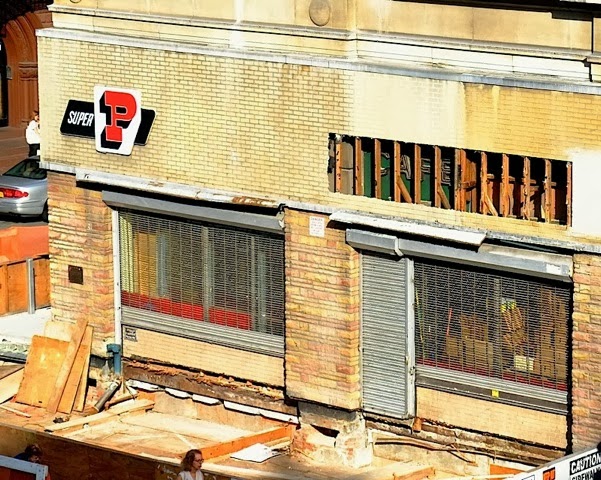
They are doing some construction on the building at 54 W. 74th Street, near the corner of Columbus, and an old neon sign reading "Cafe"—likely part of a sign that once said "Cafeteria"—was uncovered. An observant reader noticed and sent me the above photo.

A Pioneer market is still in place there—you can see the old "P" logo. The reader says it's been there since 1959. Apparently, it's a bit of a local institution. The construction work is being carried out by the landlord.

I could find out nothing about the name or nature of the cafeteria that once sat here. But the building itself has a lot of history. 54 W. 74th is part of a row of neo-Georgian buildings at 18-52 West 74th built in 1904. They were among the last private houses built on the West Side, and—according to The New York Times—the final development project of the Clark family, who built the Dakota.

(Photo credit: Geoff)

22 October 2012

THE UNION STREET PROJECT: 141 Union Street, Redux


This is the latest post of "The Union Street Project," in which I unearth the history of every building along the once bustling Brooklyn commercial strips of Union Street between Hicks and Van Brunt, and Columbia Street between Sackett and Carroll. 

I wrote about 141 Union Street for this series back in June 2011. Among the things I discovered at that time was that, in the 1920s, the address was the home to a lovely looking pastry shop, as you can see from the Municipal Archives photo below. R. Bottaro Pasticceria was the name of the place. I was not able to learn anything more about the shop.


Now, more than a year later, I do know more. I was contacted by the great-grandnephew of the owner. He told me the pastry shop was run by his great uncle, Pietro Bottaro. (The shop was thus called P. Bottaro, not R. Bottaro as I stated previously.) He came from Palermo, Sicily, around 1907-10, and opened the pasticceria around 1910. "His brother was my Grandfather who settled in Boston in 1907," wrote the reader. "My mother said they would always get a box of Italian cookie for Christmas from Uncle Peter. His wife was Vincenza and his children Salvatore, Anthony, Albert, and Santina. They lived at 17 1st Place in Brooklyn." The shop was there until sometime in the 1940s.

The best part of this new communication was the photo that the reader sent along, of his great uncle standing proudly in front of the store. Here it is:

18 January 2012

The Old Pointy House Down Union


This post is not part of the "Union Street Project," though the house in question is on Union Street, and we're looking at before and after pictures. 76 Union is nearly at the end of that long Brooklyn street, a few doors up from Van Brunt Street. It's one of a pair of narrow, peaked buildings that are unique to the area. Recently, a regular reader mentioned to me that he had always been interested in the buildings and wondered if I knew anything about it. Since they've always intrigued me as well, I decided to mail away to the Municipal Archives for a picture.

The tax picture tells us that the building has taken some knocks over the years—the arched window at top has been lopping in half, the other windows robbed of their unusual lintels, and the doorway obscured by an awful metal hood—but basically looks the same. The old chimney, the little dormer window on the roof, the fire escape, they're all the same. (74 Union, next door, has been completely refurbished and is in much better shape.)

16 January 2012

THE UNION STREET PROJECT: 13 Union Street


This is the fifteenth post of "The Union Street Project," in which I unearth the history of every building along the once bustling Brooklyn commercial strips of Union Street between Hicks and Van Brunt, and Columbia Street between Sackett and Carroll.

When I submitted my request to the Municipal Archives for a picture of 136 Union Street between Hicks and Columbia, I got back a piece of paper saying the archive could not locate the photo. First time that has happened.

But the old photo of 134 Union, as well as local neighborhood lore, shows me that, before being the Everyday Athlete gym, it was an Italian bakery that specialized in Panella bread. That name of the bakery I do not know.

In 1899, 10-year-old Mary Hardy fell from a window here. She survived. Miles Purdy wasn't so lucky two years previous. At age 54, he was found dead in his bed. That is all, except that the building has been heavily altered over the years, and not for the better. Nothing of the original facade remains.


11 January 2012

THE UNION STREET PROJECT: 134 Union Street


This is the fourteenth post of "The Union Street Project," in which I unearth the history of every building along the once bustling Brooklyn commercial strips of Union Street between Hicks and Van Brunt, and Columbia Street between Sackett and Carroll.

134 Union Street was obviously built by the same outfit that erected 132 Union. Unlike its brother, the little bathroom windows were bricked over at some point. But the cornices and fire escapes remain the same.

The address has been a laundromat for some years, but, as the below tax photo (barely) shows, it was once a market in the early-to-mid 20th century. The nature of the market and its name can not be learned because of the damn pushcarts that block the view of the storefront. I used to find those pushcarts charming, but too often they've gotten in the way of my pictorial research. 

Beyond the picture, I have found out little about this address, except that one Mary Buonarati, 17, lived here, and got married in September 1923. Not much, but there you are.

AUTHOR'S NOTE: I have collected all the "Union Square Project" columns in one place. The can be found near the top of the right hand bar of the blog. 

10 January 2012

Smith Canteen Preserves Pharmacy Past


I walked into Smith Canteen, the new trendy coffee and lunch joint in Carroll Gardens, and thought: another new Brooklyn place trying to look like old Brooklyn. But no. The tile floor and tin ceiling and wooden shelving are old. They're all part of the old pharmacy that once occupied this space many years ago. I'd never noticed because for years this corner space was a gallery that had its walls covered up in black. There were no windows through which to notice the old architectural details.

UPDATE: This, according to the Smith Canteen site: "the location was a pharmacy as early as 1901. The article, from that year, talked about the pharmacist’s engagement to a countess from Italy, who was sailing to New York from Europe. Much of the original space remains–the tile floor, the woodwork, the mirrors and half of the ceiling. (The other half was falling down and had to be replaced.) Some of the original zinc-lined cabinetry remains as well. It was probably used to keep things cool in the pre-refrigeration days. Jane didn’t remove anything from the space, except some modern glass shelving and light fixtures, and designed the new components around the original ones. The space inspired other aspects of the project as well. The logo, by M+E, references the burgundy floor tiles, and the color of the counter references the blue-green tiles."

09 January 2012

THE UNION STREET PROJECT: 132 Union Street


This is the thirteenth post of "The Union Street Project," in which I unearth the history of every building along the once bustling Brooklyn commercial strips of Union Street between Hicks and Van Brunt, and Columbia Street between Sackett and Carroll.

It's been a half a year, but now I'm back with a few more additions to my ongoing Union Street Project.


The House of Pizza and Calzone, at 132 Union Street, is the second oldest, and second most famous, business on the block (the first being the century-old Ferdinando's Focceceria). It was founded in 1952 and is now on its third owners. Paul Diagostino, the current owner, bought it in 2004 from Onofrio Gaudioso and John Teutonico, the raspy-voiced old guys who bought the restaurant in 1963 after working there together for five years. Who founded the pizzeria, I can not say. But one thing I do know—it used to be located a few doors to the west many years ago. It's present location, at 132 Union, is its second. (I believe the original building no longer exists.) According to the Department of Building, they've been at 132 since 1959. I love the Certificate of Occupancy's description: "retail sale of pizza pie and hot sandwiches."

29 December 2011

Sign's History Revealed


Back in June 2010, I puzzled over this sign at 30 E. 29th Street in Manhattan. It seemed so much older than the restaurant, Campanile, that sat under it.

Recently, a regular reader, the author of Project Neon, wrote it to tell me she had cracked the case. It used to be called the Weathervane Inn. It was founded by Nat Levine, an immigrant from Poland, who moved here in the 1920s, and ran a place called The Milk Bar on Nassau Street prior to opening the Weathervane. Patrons included Joe Namath, Lauren Bacall, and Joe Louis.

The Levines liked the sign as much as I do. To wit: "The neon sign was considered important enough that they carried a service contract that meant the minute a single letter went out a service person immediately came to fix it." If only such devotion was more evident today.

The Weathervane was sold in 1973 

03 October 2011

The Neon We've Lost


The way the City is run under Herr Bloomberg, we've gotten used to old, timeless, irreplaceable mom-and-pop businesses disappeared at a rapid rate.

Lately however, the City has suffered a string of lost businesses that take their glorious neon with them, leaving the burg all the more visually bereft. Hinsch's, the Bay Ridge soda fountain, was only the latest. It had one of the greatest, and oldest, neon signs in the town (photos courtesy of Project Neon). Here are a few more.


16 August 2011

The Never-Ending Dangerous Eyesore of Hamilton Avenue


The intersection of Van Brunt, Summit and Hamilton in Brooklyn—known to most folks as the entryway to the gentrified end of Red Hook—was never a beauty spot. But for the past two years it's been a downright eyesore and hazard to the local residents.

The arrival of Fairway and IKEA can be blamed for the pile-up of barricades and signs at this crossroads. Before those political-string-pulling institutions came to Red Hook, the intersection was a simple affair. Van Brunt was a two-way road below and above Hamilton, so if you were headed north from Red Hook, you could simply drive across Hamilton and keep on going. If you wanted to go right on Hamilton, you could. And the two-block stretch of Summit was one way headed west.

27 July 2011

Oldest Picture of Columbia Street I've Ever Seen


This is sort of a "Union Street Project" update.

Last week, I posted on the history of 110 Union Street, the spot at the southeast corner of Union and Columbia in Brooklyn. Readers may recall that the space that today looks like this...


....used to look like this in the 1940s:

21 July 2011

THE UNION STREET PROJECT: 110 Union Street


This is the twelfth post of "The Union Street Project," in which I unearth the history of every building along the once bustling Brooklyn commercial strips of Union Street between Hicks and Van Brunt, and Columbia Street between Sackett and Carroll.
Today, 110 Union Street stands at the southeast corner of Union and Columbia. Prior to the 1970s, this address did not exist. The building on that corner had an entrance on Columbia, not Union, and was first (in the 1850s) 201 Columbia, then later in the 19th Century 227 Columbia.

As the picture from the 1940s below tells, the corner was the home of Brody's, which looks like it was a lovely little luncheonette and soda fountain. Upstairs was a dentist equipped with a x-ray. The odd rectangular outlines between the second-story windows make me think the building was festooned with advertisements at an earlier time.

I have been told by many that this corner was also the site of a vegetable market for many years, but nobody remembers the name, and I haven't been able to confirm it through any hard evidence. 1898, 227 was the location of the Bolton Drug Co., which had four Brooklyn locations. They heavily advertised a wonder drug called Mi-o-na in 1902.

This building and the one next to it no longer exist because their foundations were destabilized during the great Columbia Street sewer dig that blighted the area in the 1970s. Some people say the City let the construction drag on as a way of undermining the crime culture that then ruled the area. Many old buildings along Columbia either fell down or were ripped down as a result, and the apartment building that houses Union Max was erected in the 1980s. It's bland and dull.


PREVIOUS "UNION STREET PROJECT" POSTS

11 July 2011

THE UNION STREET PROJECT: 143 Union Street


This is the eleventh post of "The Union Street Project," in which I unearth the history of every building along the once bustling Brooklyn commercial strips of Union Street between Hicks and Van Brunt, and Columbia Street between Sackett and Carroll.

143 Union is the center building in the trio of matching, four-story structures in the center of the north side of Union Street between Columbia and Hicks. I got some early information from a neighborhood vet that the store in the base used to be a florist. This photo shows that to have been the truth. A. Castiglia Florist, if I read correctly. This photo is from the 1930s, and my source was a kid there in the 1960s, so the florist was there a few decades.

27 June 2011

THE UNION STREET PROJECT: 142 Union Street


This is the eleventh post of "The Union Street Project," in which I unearth the history of every building along the once bustling Brooklyn commercial strips of Union Street between Hicks and Van Brunt, and Columbia Street between Sackett and Carroll.


I always thought 142 Union Street was a fairly recent addition to the block. The squat, two-story, red-brick, faux castle just didn't have the look of antiquity about it. Perhaps it was an unfortunate creation of the 1970s.

Not so. The below 1920s photo shows the structure had the same silly, grandiose look back then. In fact, the facade is remarkably untouched!

21 June 2011

THE UNION STREET PROJECT: 153 Union Street


This is the tenth post of "The Union Street Project," in which I unearth the history of every building along the once bustling Brooklyn commercial strips of Union Street between Hicks and Van Brunt, and Columbia Street between Sackett and Carroll.


153 Union, the building that forms the eastern wall of the northern side of the block between Columbia and Hicks Street, is the structure just to the right of the famed Ferdinando's Focacceria. For at least a couple decades, it has been the bare-bones, deli and cigar store known as Sonny and Nancy's. They advertise themselves as the home of four lottery winners, and have done so for ten years or so. Which means no one has scored since 2000.

Sonny died a few years back; Nancy runs the store now. It's a nice place, though I find it curious that Nancy knows nothing about the cigars she sells. Old-time locals congregate here, and a newbie can be given the fisheye. There are framed photos of old-time Union and Columbia Streets on the walls.

I have been told anecdotal stories that the shop used to be a toy store before Sonny and Nancy came along. But before that it was certainly the Union Center Meat Market. You can see the building in the 1920s below. It's the shop to the left. As the photograph illustrates, the wirework around the windows today is original, though the fanciful brickwork has been simplified over time. I've learned nothing else about this butcher. But then, butchers rarely make the news.


An added bonus to the archival photo above is that it features 155 Union Street, a building that has not existed for half a century. It was one of the many structures torn down on this side of Hicks to make way for the BQE. Today it's a vacant lot, but in years past, as we can see, it was a barbershop. Next to it was a garage.

PREVIOUS UNION SQUARE PROJECT ENTRIES

13 June 2011

THE UNION STREET PROJECT: 141 Union Street


This is the ninth post of "The Union Street Project," in which I unearth the history of every building along the once bustling Brooklyn commercial strips of Union Street between Hicks and Van Brunt, and Columbia Street between Sackett and Carroll.

The buildings 141, 143 and 145 Union Street were built as a block. Aside from various modern paint jobs, and certain filled-in windows, they are near-identical. They stand out on the block for a number of reasons. They are four stories tall on a block of three-story buildings. The lintels are very decorative, and the cornices are intact. I have not been able to discover the name of the builder of the three structures, but he's to be applauded.

The westernmost building is 141 Union Street. All three building once had stores on their ground floors, though only one has a working business today. In the 1920, 141 Union was the home to a lovely looking pastry shop, as you can see from the Municipal Archives photo below. R. Bottaro Pasticceria was the name of the place. I have not been able to learn anything more about the shop.


I also learned that 141 Union was a boarding house around the turn of the 20th century. And a boarding house quite well known to the police it was! In 1888, a man named Robert Morris, who lived here, charged his wife with being a "habitual drunkard" who had not been sober in three months time. She was sent to the "Inebriates Home." This same Robert Morris, a tailor who seems to have had a hard life, was accused of stealing a coat in 1886. The charge was dismissed, as the owner of the coat had refused to pay for the repair work Morris had done.

In 1897, John Drummond, who resided here, was almost killed by Palo Bartolo. Bartolo was arrested. Meanwhile, a nice Swedish girl, newly landed and living here, was looking for housework in 1889. I wonder if she knew the Morrises.

PREVIOUS "UNION SQUARE PROJECT" POSTS

07 June 2011

THE UNION STREET PROJECT: 139 Union Street


It's been a good long time since I posted an edition in The Union Street Project, in which I trace the past of every building on Union Street, between Hicks and Columbia, in Brooklyn. There's a reason. And that's: gathering information on these piles of bricks is damned difficult.

The newspaper archives provide only so much material. And the memories of locals are spotty at best. There are several local legends in my area whom I was instructed to seek out. They know everything about the old neighborhood, I was told. I did seek out these people. And I found out that they know almost nothing. I'd ask them specific questions and they'd answer in generalities and make guesses.

These dead ends temporarily halted my project. Finally, I knuckled under, resorted to the Municipal Archives and ordered a number of (expensive) archival shots of various buildings. Photos don't lie.

One of the photos I ordered was for 139 Union Street, seen above. This interesting looking building is on the south side of Union. Unlike other structures on the street, there is no trouble tracing the date of its erection. It says so on the cornice: 1928. This means it's one of the newer buildings on the streets. It also means that it supplanted a previous building, for an 1855 map has a building standing on this spot.

11 April 2011

THE UNION STREET PROJECT: 149 Union Street


This is the seventh post of "The Union Street Project," in which I unearth the history of every building along the once bustling Brooklyn commercial strips of Union Street between Hicks and Van Brunt, and Columbia Street between Sackett and Carroll.
Union Street between Hicks and Columbia has always been a commercial strip, lined with stores. A map I have from 1927 indicates that nearly every building on the block contained a shop; you can still see this was the case today; even though some edifices don't contain businesses today, the architecture obviously shows that they once did.

149 Union, on the north side of the street, is a rare exception. As far as I can tell, it was always a residence. I believe it is one of the oldest buildings on the block, dating from the 1850s or before, and is a brother to 147 Union Street, seen here the left. It's in better shape than 147, but its height, Federal-style doorway and unusual wooden cornice betray its age.

04 April 2011

THE UNION STREET PROJECT: 147 Union Street


This is the sixth post of "The Union Street Project," in which I unearth the history of every building along the once bustling Brooklyn commercial strips of Union Street between Hicks and Van Brunt, and Columbia Street between Sackett and Carroll.

This shortish building is 147 Union Street. It's on the south side of Union, near Hicks. None of the buildings I'm writing about in this series are landmarked or protected in any way. Which is a shame, because a number of the buildings in Cobble Hill and Carroll Gardens west of the BQE gulch are among the oldest survivors in Brooklyn. This building, as well as neighboring 149 Union, date at least from 1855, and, judging from the architecture, probably go back to the 1830s, making them among the first structures in the Columbia Street area, formerly swampland. The low roof, stark simple design and windows are fairly Federalist. And the amazing, unusual wooden lintels (see below) look like they could be original. I don't know if I've ever seen anything like them. The door, too, with its window above the frame, is Federalist style, and of a sort I've only seen in a few places around the area.

As one can tell from the facade, this building had a history as a storefront. Of its 19th-century life I've discovered nothing, except that resident Ellen Hansen lost a clock to a "sneak thief" named Frederick Smith here in 1885. But for at least the first five decades of the 20th century, this was the address of the Pastore Funeral Home, first run by Gennaro Pastore, who lived in the building as well, and then by his son Joe.

Gennaro's story is a sad one. In August 1921, he sent his young son (not Joe) to a local hardware merchant to buy some fuel oil for his kitchen stove. The young boy was sold gasoline by mistake. As the evening meal was being prepared by the child and his mother, the can of gasoline, set by the stove, caught on fire. When Gennaro rushed into the room, wife and child were in flames. They died the next day of their injuries.

Gennaro, who was also injured, sued the hardware merchants, Crystal and Morris Cohen, for $80,000. Whether he won or not, I do not know. But it hardly matters. Gennaro himself died in September of that year.

According to a Brooklyn Eagle account, the funeral home was still in operation in the 1940s, run by Gennaro's son Joe.


PREVIOUS "UNION STREET PROJECT" ENTRIES

31 March 2011

A Hell of a Rotten Idea


There is, of course, no limit to the number of stupid, city-soul-killing ideas that arise in Bloomberg's dystopian New York. But even among the most bonebrained notions, the removal of the Essex Street Market from the Lower East Side stands out in its wrongheadedness.

The Daily News reported earlier this month that Community Board 3 is considering whether the Essex Street Market should move when the city starts developing something called the Seward Park Urban Renewal Area. Community Board 3 passed guidelines in late January for the development of a stretch of parking lots along Delancey Street, and the renewal project includes the plot where the market stands and the guidelines suggest a possible move.

Why the removal of this beautiful and wonderful market, built in 1940, would constitute "renewal" for the area, no one suggests. Nor does anyone explain how the multifarious market, full of food merchants both historic and new, is dragging down the neighborhood. Anyone who visits the Essex Street Market regularly—or has stumbled upon it be accident—know was a flavorful experience a stroll through its stalls can be, and how much character and authenticity and neighborhood feeling it lends to an area that is increasingly plastic.

There is now a "Save The Essex Street Market" petition, so go check it out and sign before CB3 can act any further on this idiotic idea.  

Apparently, the Hunts Point wholesale produce market in the South Bronx might also decamp, perhaps to New Jersey. Because, you know, New York doesn't need any kind of industry or anything like that. We're good the way we are. As long as we keep the Yankees, Mets, the New York Stock Exchange, new chain franchises and plenty of condo developments. We're good.