12 July 2011

Coogan Building Remnants Found in City's Salvage Warehouse


City preservationists remember the Coogan Building.

The structure, which once stood at the corner of 26th Street and Sixth Avenue, was an early victim in City Hall's long campaign to rid the Landmarks Preservation Commission of its teeth. The Coogan was built in 1876 for use by the Racquet Court Club, predecessor to the modern Racquet and Tennis Club on Park Avenue. Architecture historians called it a predecessor of the modern skyscraper. It had been granted landmark status in 1989, the Commission calling it ''an excellent and early example of arcaded, tripartite facade design, of the type later expounded by Louis Sullivan.'' But then, later that year, Mayor David N. Dinkins and the New York City Board of Estimate rescinded that designation. It was torn down a decade later and replaced by a 39-story luxury apartment building.

Why do I bring up the Coogan. Because a couple days ago, I posted an item lamenting the fact that the City was auctioning off—to one single high bidder—all the contents of Williamsburg's Architectural Salvage Warehouse, which, from 1980 to 2000, "accepted the remains of demolished structures."

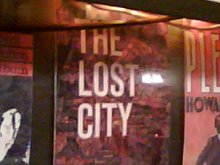
A reader managed to get inside the warehouse and take a group of photos. Among the shots was the above picture—showing pieces of the Coogan Building. "March 2000—Item #90."


Here's how the Coogan looked in life. It's the impressive building in back.

11 July 2011

THE UNION STREET PROJECT: 143 Union Street


This is the eleventh post of "The Union Street Project," in which I unearth the history of every building along the once bustling Brooklyn commercial strips of Union Street between Hicks and Van Brunt, and Columbia Street between Sackett and Carroll.

143 Union is the center building in the trio of matching, four-story structures in the center of the north side of Union Street between Columbia and Hicks. I got some early information from a neighborhood vet that the store in the base used to be a florist. This photo shows that to have been the truth. A. Castiglia Florist, if I read correctly. This photo is from the 1930s, and my source was a kid there in the 1960s, so the florist was there a few decades.

A Good Sign: Fine Touch Klean Cleaners


The fonts are super curious. But the name's even curiouser. And two spellings of "Clean"! On First Avenue and 74th in Manhattan for 30 years or more.

10 July 2011

City to Secretly Sell Hundreds of Historical Treasures to One Rich Dude


This story in City Room infuriated me as nothing has in months.

So, apparently, there's this warehouse out in Williamsburg that's full of rare, one-of-a-kind artifacts from New York history. A chunk of a famous building here. A sign or piece of furniture from a vanished business there. A section of the facade of the old Helen Hayes Theatre. A block of Indiana limestone marked NYB, from the old New York Butchers on 11th Avenue.

From 1980 to 2000, the Architectural Salvage Warehouse "accepted the remains of demolished structures: shuttered theaters, once-bustling slaughterhouses, even old signs from the post office at Grand Central Terminal." This precious detritus was then put in the Brooklyn building. Where it sat. And sat.

And now the Landmarks Preservation Commission—that completely sensitive and wise body that decides which old buildings can stay and which will go—is going to auction it all off. Auction it ALL off. The whole of it. One lump package. To one person. One entity. ONE!

What the hell?

Why could the stuff not be auctioned off in pieces, or lots? That would afford people who don't have a lot of cash—but possess a lot of interest—the chance to claim some of these treasures. The kind of individual who would step forth to bid on a single item would most likely be an amateur historian or nostalgist (or blogger) who would nurse and lovingly preserve the artifact. Putting the entire warehouse-ful on the block means that only a super-rich party can buy it. And the chances of some millionaire really treasuring these things, or wishing to share them with the public, are next to nil. The bidder will flip the stuff, or sell it for scrap or hoard it in some vault.

09 July 2011

Lost City: Seattle Edition: Pike Place Signs


Pike Place Market, a public market that brings together 500 vendors every day along the edge of a steep hill leading down to the Puget Sound, is the spiritual heart of Seattle. It was founded in 1907. After the city threatened to tear the place down in the 1960s, a populist movement led by architect Victor Steinbrueck saved the property. (There's now a part named after him.) It's now on the U.S National Register of Historic Places and a federally recognized historic district.

The are many stalls here and you can buy most everything (lavender anything; straws filled with honey). But mostly you can buy food, from vendors and from restaurants. Some of the sellers have been here for decades. Place Pigalle was founded in the 1950s. The Athenian Inn goes back to 1909, when it was a bakery. Three Girls Bakery dates from 1912. Lowell's, seen below, started in 1957, and has three levels looking out on the water.

As for Loback Meat Co., seen above, the business no longer exists. But the sign does. As do many other fantastic signs, neon and otherwise. It's a feast of signage. Even the sign that tell you where the stairs and bathrooms are are stylish and flashy.


08 July 2011

Old Latticini Barese Building For Sale


The old Carroll Gardens salumeria Latticini Barese closed up for good in 2002, after 75 years in business. But for those of us who loved the place, there was always the old painted ad on the side of 138 Union Street—the cheese shop's former home—to comfort us and nurse our nostalgia. It is simply, bar none, one of the best faded ads in all of New York City. And I've always been grateful to the real estate office that took over the space that they never painted over it.

Now, it might be in danger. The real estate office has moved out (there never seemed to be anyone in there, anyway) and the building is up for sale, for just under $2 million. The building is not in a landmarked area, and could be torn down. While I think that is unlikely (there are six apartments inside, all occupied and three of them stabilized), there is the chance that a new owner would want that ad gone so as to make the building look "modern," or in order to be able to sell that wall space to another advertiser. Land owners and developers are not sentimental. To destroy that work of old world art would be a crime.

06 July 2011

Lost City: Seattle Edition: Virginia Inn


The Virginia Inn is on First Avenue, just up a very steep hill from Pike Place Market, the teeming open-air/indoor food and wares market that gives Seattle's waterfront its vibrancy—and which, unthinkably, the city tried to tear down in the 1960s and replace with a parking structure and a convention center. (I've never met an "urban renewal" scheme from that era that wasn't a piece of numbskulled, short-sighted, civic idiocy.)

The Virginia Inn is older even than that market. This corner was a bar, called the Virginia Bar in 1903. During Prohibition it was reportedly a cardroom. Irritatingly, the website for the current restaurant only talks about the joint's history from 1981 on (aside from saying it had a "colorful Skid road history"). That's when Patrice Demombynes and Jim Fotheringham took up ownership. They converted it into a casual French bistro and bar, and earned a reputation for fostering art exhibitions.

Aside from the great neon sign, and the bar, which looks on the oldish side, the Virginia Inn has a fairly contemporary look inside. The floor plan has altered; the place expanded into a neighboring storefront recently. I've read accounts that say it's been in "almost continuous operation." Almost. Perhaps the hiccup in time was Prohibition. But I'm pretty good at sniffing out former speakeasies. And the Virginia feels like on. In 2008, police found some old bones in a crawl space below the Inn, but it was determined that they weren't human remains. 

Below is an picture of how the bar looked in the first decade of the last century. At that time it was owned by two men called McNamara and Herdman. Not sure what the boat nonsense is all about. Probably something to do with the appalling state of the street. Imagine a frontier city having dirt roads and Seattle weather. A prescription for year-round mud.

Sheltered Carriage Houses


I don't stroll down Washington Mews much. Though the ancient alley, north of Washington Square Park, is beautiful, it reminds me too much of New York University's bottomless appetite for real estate; so many of these former carriage houses are now owned by the monster, Village-eating college.

Still, it's a shame to deprive myself of such quiet beauty. So the other day I accepted the invitation offered by the open gate and walked the length of the Belgian-blocked path.

05 July 2011

The Second Floor Matters on Sixth Avenue


Walk Sixth Avenue between 14th and 34th Street and you may notice something different about the older buildings that line the street. As often as not, their second stories are not just blank brick face, not apartments, but what seem to be elevated storefronts. That's because they were indeed built as storefronts. Until 1938, this avenue was dominated by the Sixth Avenue Elevated train. The train thundered right by the second level of every building, making that story very valuable real estate. Every straphanger couldn't help but notice the stores that passed by the train windows.

Today some of these spaces are still in use as shops. Others are not. The overall visual effect, however, is, to me, very attractive, in an utterly prewar way.

01 July 2011

The Hidden Plumber


The sign at 1390 Second Avenue says Klausner Supply. But you look at the display in the storefront window and there are no plumbing fixtures. Just a lot of frou-frou pillows and drapes and other accoutrements of interior design.