09 September 2011

Who Goes There? El Parador Cafe


One question. Why is it called "Cafe"?
Who Goes There? El Parador Cafe
El Parador opened the year before Kennedy was elected, when Mexican food was still an exotic thing. It began at Second Avenue and 31st Street and then moved ten years later to its current location on 34th Street, a point even further off the midtown map. Another shift and it would have pitched into the East River.
Its out-of-the-way situation is probably what made it attractive in those early days as a cheater's joint. Husbands would take their chippies there to not be seen under the room-darkening red light bulbs. The founder was one Carlos Jacott, a native of the town of Dolores in Chihuahua. When he decided to retire in 1990, he cast an eye among his family and close friends for a successor, and decided upon Manuel Alejandro, a Spaniard with whose father he had done business. Manny's son Alex now runs the place.
Though the interior has received a sleek revamp under the Alejandros, it still has the earmarks of an veteran restaurant—long awning outside, cloak room just inside the door. The same goes for the menu. Among more modern temptations are El Parador standbys like eye-watering Jalapenos Rellenos, Pollo Parador ("allow 30 minutes") and Mole Poblano ("allow 25 minutes"). The menu also encouraged patrons to ask for any old dish they may remember from the past. Service comes with a bit of panache and ceremony, the waiters making like magicians unveiling their latest trick. When you order a beer, they bring the bottle and the glass on a tray, pour the beer into the vessel, and then place the glass on the table before you. A Corona has never gotten such grand treatment.
The clientele, Alex said, come from everywhere—around the neighborhood, across town, other states. Famous folk and politicians, too. "It's a rare week that someone doesn't come in here and say, 'The last time I was here was 40 years ago.'" On the night I went, it was a popular place for girlfriends to confab over sangria or red wine or blended Margaritas. A duo of working girls on either side of my table provided me with a dinner accompaniment of non-stop, stereophonic gossip. They never stopped talking, and they never stopped drinking. And boy were they having a good time. Across the way, a sextet of young office friends sat down for dinner. Three men in bulging blue dress shirts shared a business meal. On the other side of the room, three far more curious men chilled in matching white track suits.
Romance has not completely abandoned El Parador, though today it takes on a legit form. On the wall of a corner booth in the back, near the kitchen, are a few gold plaques. The first says such and such a couple became engaged in this booth in 1983. The second says such and such had their first date there in 2001. The last is also about the second pair. They got married in 2003. 
—Brooks of Sheffield

07 September 2011

A Good Sign: Barton's Sportswear


In Sheepshead Bay.

06 September 2011

Dust in the Wind


The wonderful cemetery at lower Manhattan's old Trinity Church was open to the public the other day, so I took took the chance to roam around, looking at the graves of Alexander Hamilton, Robert Fulton and other lesser-known Colonial and Revolutionary War-era souls.

I spotted this gravestone above, its name and dates completely worn away by the elements. Good thing that some thoughtful person had gone to the effort to place a metal plaque at the head of the grave to identify the...oops. Guess that didn't work either.

(If you peer intently, you'll see this is the grave of John Moore, one of the founders of the New York Chamber of Commerce. There are other such plaques around the graveyard, all for C. of C. men.)

01 September 2011

Three Survivors


Here are a set of old triplets on W. 46th Street east of Broadway in Times Square. Aren't too many left in this area with this level of age on them. The trio is more remarkable in that they're obviously a set, all the same height and width, built at the same time. They may look different now in terms of facade, but take a close look at the window frames on the third and fourth floors (below). They're identical.

31 August 2011

Lost City: New Jersey Edition: Jesus Saves—at Ciano Service Center


The Ciano Service Center in Garfield, NJ, is interesting on its own terms. The architecture, the graphics, the aura, the fact it is abandoned. But zoom in and it gets even more interesting. Did Jesus ever weigh in on used cars?


Getting Specific


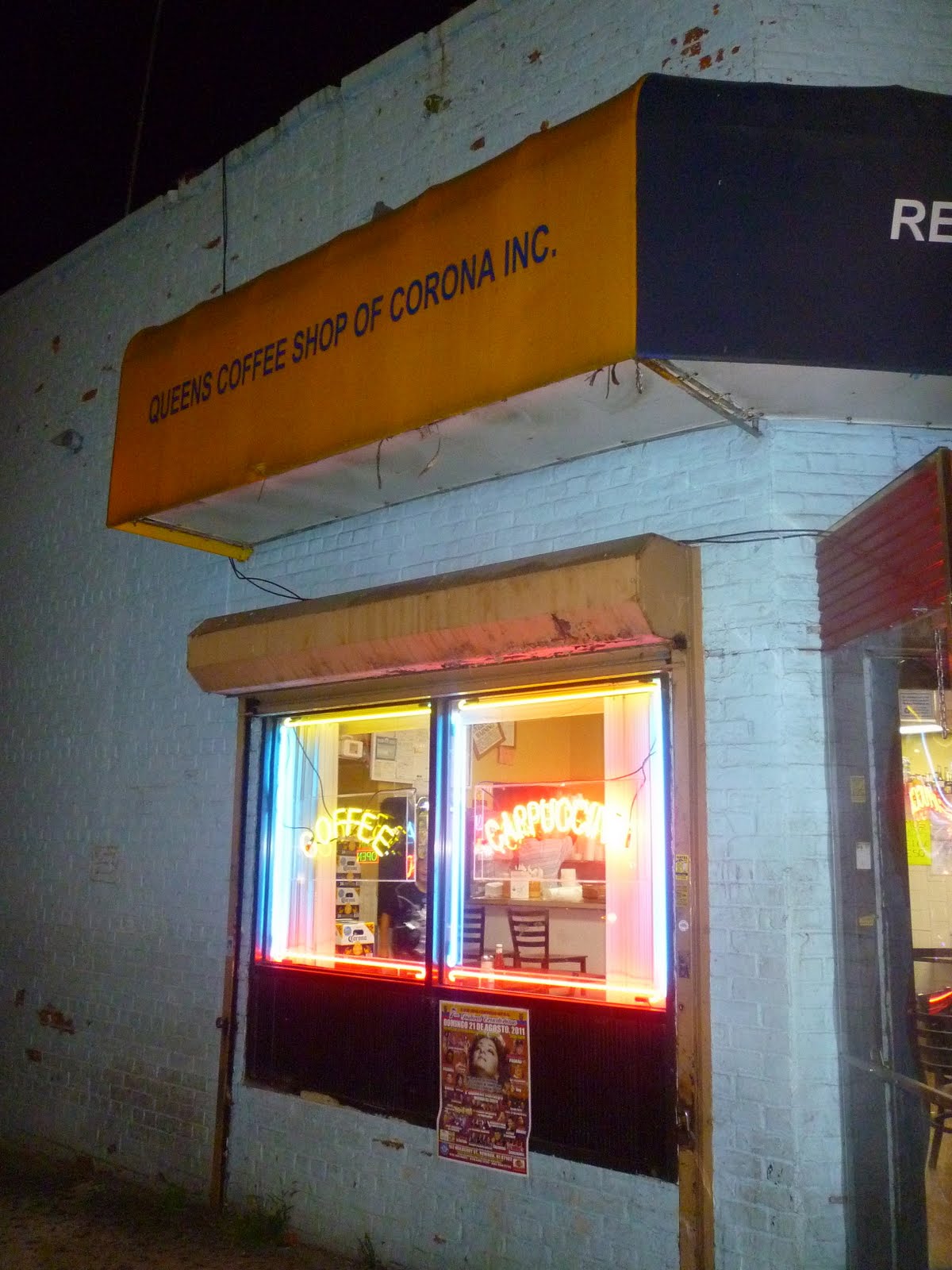
No mistaking where this coffee shop is. Pretty heavy name for a hole in the wall joint. Is "Inc." really necessary? Imagine saying to the missus, "I'm headed over to the Queen Coffee Shop of Corona."

30 August 2011

Tawdry Jewelry Store Rightly Punished for Desecrating Gage & Tollner


The Landmarks Commission finally did something right.

According to the NY Post, Landmarks isn't happy with the tacky jewelry store that has moved into the landmarked Gage & Tollner space in downtown Brooklyn. "Inspectors last week served the operators of Ladies and Gents discount jewelry store with a notice informing them that they illegally installed silky pink partitions a few inches away from the buildings historic walls. They were told on Aug. 18 they must apply within 20 days to the Commission for permits to keep the partitions or risk be fined up to $5,000 and then potentially additional penalties of up to $250 a day that the temporary paneling remains. Sources said the city wants the partitions removed."

The space sat empty for months after its last tenant, an Arby's, closed late last year. But at least the Arby's cared a little. They had to jump through plenty of hoops to please the Commission and refurbished much of the classic interior. Ladies and Gents discount jewelry covered all that work up, slapping up some garish pink walls, and basically turning an elegant room into a trashy space. I hope they are fined out of business.

Charles Pfaff Died Broke


I had read many a yarn about the great hosts, dandies, swells, bon vivants and society men of New York's history prior to World War II. And one thing they all seem to hold in common is this: they die broke. Or in debt.

Charles Ignatius Pfaff was a jolly German who set up one of the first—or certainly one of the first famous—bohemian gathering places in New York City. Pfaff's was located at 653 Broadway near Bleecker. He ran a couple of places before that, and one after, but this was the famous one, the basement space that attracted, from 1860 to 1875, the likes of Walt Whitman, William Winter (the leading American dramatic critic of the 19th century), George Clemenceau (French statesman and journalist), Artemus Ward (humorist and editor of Vanity Fair), Fitz-James O'Brien (a writer of early examples of science fiction) and Henry Clapp, Jr. (a publisher of the Saturday Press—for which almost everybody else at Pfaff's wrote—promoter of free love and "Leaves of Grass" and the "King of Bohemia"). Also writer and actress Ada Clare, one of my favorite bohos of all time because of her bizarre death: she died of hydrophobia after being bit by her favorite terrier while visited her agent's office.

Six Windows on Sackett


This long, two-story building on Sackett Street, near Henry, in Brooklyn, has always caught my gaze. And not just because of what it was—carriage houses or stables, obviously—but because of its simple, 19th-century beauty. Something about the long, double cornices and the row of six identical, second-story windows speak to my architectural heart.

A little digging, however, reveals that the building was not obviously a stables or carriage house. It may have been at some time in the 19th century—the building is one of the oldest in the area. But in 1902, according to the Brooklyn Eagle, this was a tin shop owned by Martin Anderson and his brother. In that year it was robbed by two locals of 24 bars of lead solder and two bicycles.

29 August 2011

A Good Sign: Geshmake Fish


Traditional Gefilte Fish in Riverdale, The Bronx.